

Amman- 4 June, 2104
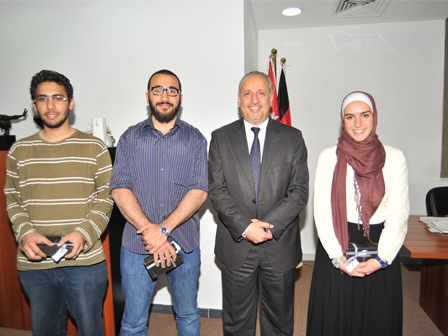 Prof. Natheer Abu.Obeid, the GJU President, honored the GJU Bachelor Research Team (Farah Atour, Firas Dabbas, Ghaith Al Shishani, Hisham Maher) and their supervisor, Prof. Nabil Ayoub, for their achievements on the microgravity proposed experiment in the Fellowship Program “Drop Tower Experiment Series”.
Prof. Abu Obeid expressed that GJU is proud of the team members and emphasized that this creative achievement is a great success not only for GJU, but also for the kingdom. He also promised the team members that GJU would be ready to support and fund their work.
The GJU Bachelor Research Team has been selected by the United Nations Office for Outer Space Affairs (UNOOSA), offering the team an opportunity to conduct their own microgravity experiment in the Fellowship Program “Drop Tower Experiment Series”.
This opportunity is considered as part of the Human Space Technology Initiative (HSTI) within the framework of the United Nations Program on Space Applications, and in close cooperation with the Center of Applied Space Technology, Microgravity (ZARM) and the German Aerospace Center (DLR).
The UNOOSA also invited the team members to conduct their own microgravity experiment series at the Drop Tower Bremen in Germany.
The Drop Tower Bremen in Germany is a ground-based laboratory with a drop tube of a height of 146 meters, which can enable short microgravity experiments to be performed in various scientific fields, such as fluid physics, combustion, thermodynamics, material science and biotechnology.
The DropTES Fellowship Program was open to research teams from non-space-faring countries. Teams should consist of up to four Bachelor, Master and/or PhD students who must be endorsed by an academic supervisor.
The GJU Bachelor Research Team enjoyed working on the proposal entitled "Stabilizing the Electrodynamic Tether by using Tilger", where they proposed a new technique to stabilizing the Electrodynamic Tether.
An electrodynamic tether (EDT) is a simple idea, but one with an amazing number of uses. Electrodynamic tether is a long conductor wire that is attached to the satellite, which can act as a generator or motor, from its motion through the earth's magnetic field. And it has the potential to make space travel significantly cheaper. The lack of EDT’s widespread in common applications can be attributed to its greatest disadvantage, namely causing imbalances to orbiting payloads which analytically appears as a consequent of the action of undesired degrees of freedom made available by the system and triggered in motion across the dynamic path.
In their proposed experiment, they discussed the experimental outcomes of utilizing a tuned mass damper model (Tilger) or “Schwingungstilger” (Deutsch), and its benefit in "eliminating" tether liberations in aims of theoretically stabilizing payload orbit transfers.
The GJU family congratulates the team members, wishing them more success and progress.