
Amman- December, 2014
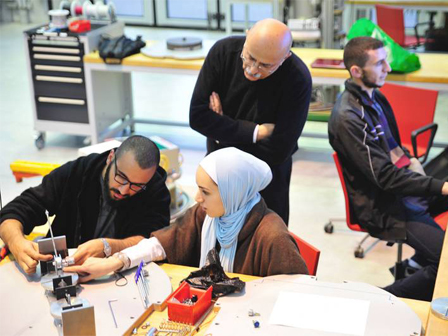 The GJU Bachelor Research Team has been selected by the United Nations Office for Outer Space Affairs (UNOOSA), (Farah Atour, Ghaith Al Shishani, Hisham Maher) and their supervisor, Prof. Nabil Ayoub, to conduct a series of microgravity experiments visited the Drop Tower facility in Bremen/Germany, to participate in an intensive and exciting research work through the UN -Fellowship program (Drop Tower Experiment Series).
The GJU students conducted their own microgravity experiment, an experimental setup for alternative energy supply of satellites in space. In the final selection in May 2014, the representatives of the jury of UNOOSA (United Nations Office for Outer Space Affairs) , the German Aerospace Center (DLR), and the Center of Applied Space Technology, Microgravity (ZARM) were convinced of the experiment value and content.
Dr.-Ing. Thorben Könemann, who manages DropTES Fellowship Program by the ZARM, said “gladly, we support the International science teams from non-space-faring countries, that they also get the opportunity to carry out experiments under space conditions”, also he praised the team’s idea and considered it very clever.
The team used electrodynamic tether which is a long conductor wire that is attached to the satellite, which can act as a generator or motor, from its motion through the earth's magnetic field. And it has the potential to make space travel significantly cheaper.
Please click the link below of the press-release by ZARM in German language about the GJUBachelor Research Team scientific visit.
Jordanische Studierende forschen im Bremer Fallturm