
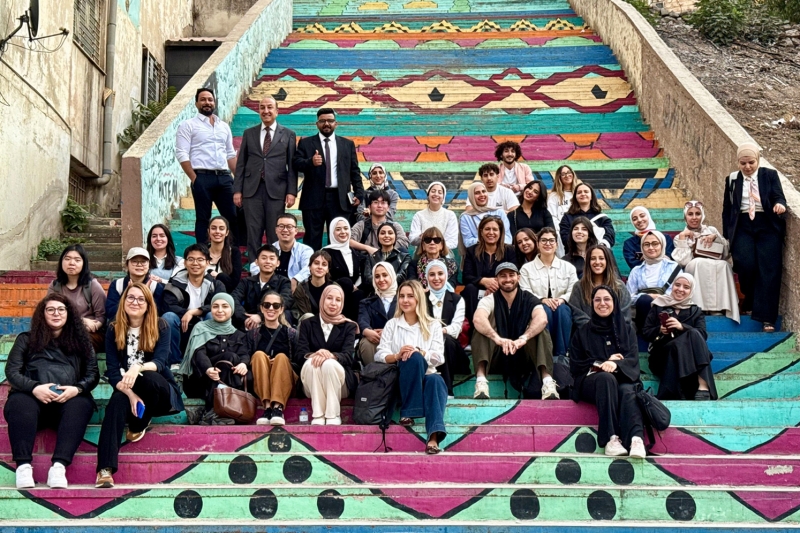
 The workshop “Protection of Informal Public Spaces – Connecting the Old and the New” was recently held at the SABE Jabal Amman Campus as part of the urban design course. The DAAD funded collaboration workshop (Taziz Program) was conducted between SABE GJU represented by Dr. Maram Tawil and Arch Tala Alsheikh with RWTH Aachen University in Germany represented by Prof. Christa Reicher, Caner Telli, Alper Al, Liliana Luga and Canan Celik, along with Wasit University in Iraq represented by Dr. Sabeeh Lafta. The project included this collaborative student-based workshop that hosted 37 students form the three universities and will also aim at a next step in exposing the students discussing their results in an upcoming workshop at the RWTH Aachen in Germany. This international academic exchange created a unique platform for discussing the significance of informal public spaces and their role in shaping socially connected, culturally rich, and resilient cities.
The workshop was attended by different professors from GJU and was opened by the Dean of SABE Dr. Omaimah Ali. It included significant inputs and lectures in addition to various forms of working sessions between the intercultural groups. Scientific inputs were planned and given by GJU professors like Dr. Rami Daher and Ind. Prof. Mohammad Khaled along with external guests like Dr. Murad Kalaldeh and Dr. Sally Hamarneh. An added value was also given through a visit and talk to the Ministry of Investment, Mr. Hamza Alhajaya – Director of the Public Private Partnership Unit at the Ministry.
Throughout the workshop, participants explored how informal public spaces—such as traditional gathering areas, neighborhood nodes, and spontaneous community meeting points—contribute to urban identity and community cohesion. The discussions highlighted the challenges these spaces face today, particularly under rapid urban transformation, and emphasized strategies to protect and integrate them within contemporary planning frameworks. Professors from both universities delivered insightful lectures, encouraging participants to approach the topic through both theoretical and practical lenses.
Students were highly engaged, working in mixed groups on case studies and design-based activities. These sessions allowed them to compare examples from Germany, Iraq, and the wider region, offering a deeper understanding of how cultural context influences the character and function of informal public spaces. The collaborative nature of the workshop encouraged meaningful dialogue and knowledge exchange, allowing participants to learn from diverse perspectives.
The workshop also served as an essential step in strengthening the academic partnership with RWTH Aachen University and initiating that with Wasit University. Both institutions expressed a strong interest in continuing joint activities, including future symposiums, research collaborations, and student exchange initiatives. By the end of the event, participants collectively emphasized the importance of balancing heritage conservation with modern urban development, ensuring that informal public spaces remain vibrant, inclusive, and protected for future generations.