
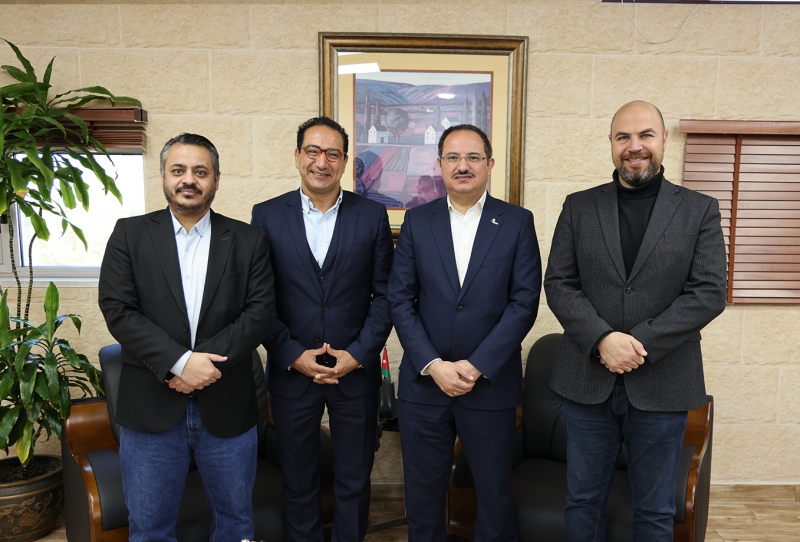
The School of Applied Humanities and Social Sciences (SAHSS) at the German-Jordanian University (GJU), represented by its Dean Prof. Haytham Althawbih and the Head of Applied Humanities Department Dr. Oliver Ritter, was honored to host Visiting Prof. Barie Al Masri from Johannes Gutenberg-University Mainz. In close collaboration with Raghad Alhadidi, the Dean’s Assistant for Industrial Links, DAAD-Prof. Markus Schmitz, and TestDaF Centre Coordinator Tarek Boutaib various learning objectives were addressed to align with the needs of students in 21st-century learning environments.
Meanwhile, the program aimed to foster digital competencies, strengthen plurilingual communicative skills and enhance intercultural competencies as well as global citizenship. These objectives were achieved through project-based teaching approaches, multimodal task design, and collaborative learning experiences, ensuring a high degree of learner-centeredness.
In a dedicated workshop tailored to the needs of pre-service teachers of the Master’s Program in German as a Foreign Language, the focus was on creating engaging learning environments with relevant and meaningful content, particularly concerning the UN Agenda 2030 and the Sustainable Development Goals (SDGs). Additionally, aligned with the European Digital Competence Framework for Educators, the workshop explored integrating digital technology. The aim was to enhance the integrated skills, knowledge, and attitudes necessary for life-long learning, while cultivating 21st-century skills such as creativity, critical thinking, communication, and collaboration.
The use of technology and electronic translation tools was addressed in Tarek Boutaib’s courses, where his expertise in state-of-the-art technology and Artificial Intelligence in the humanities was evident. He highlighted both the opportunities and challenges of these tools, ensuring ethical conduct and adherence to moral values. An illustrative case of the challenges in language translation was presented in Laila Salman’s exceptional Bachelor’s thesis on Goethe’s Erlkönig, supervised by Dr. Oliver Ritter. This work underscored the limits of technology in translation processes and the enduring importance of traditional translation skills in preserving emotions and the artistic essence of literary works.
Instructor Raghad Alhadidi delivered impactful sessions on cultivating 21st-century skills by engaging students as stakeholders in shared learning experiences in her courses Written Business Communication and Debating in Business Scenarios. Through authentic case studies tied to the SDGs—focusing on social, economic, and environmental dimensions—students developed integrated competencies for business and professional scenarios. The emphasis on effective oral and written communication equipped students with the skills required to excel in their careers.
In the Intercultural Communication course, DAAD-Lector Dr. Markus Schmitz showcased his expertise in intercultural communication and deep understanding of critical incidents. By encouraging shifts in perspective, his lectures empowered students to recognize the sources of intercultural misunderstandings. This prepared them for their German exchange year, enabling them to handle intercultural interactions effectively and confidently.
The success of this program would not have been possible without the support of Ruth Pappenhagen (GJU Project Coordinator, Hochschule Magdeburg-Stendal), Humda Qamar (Vice-Director, GJU International Affairs Department), Khalida Radaideh (Acting Director, PCAD), Mariam Abu Hussein (GEBC Exchange Coordinator). Finally, the greatest gratitude goes to our wonderful students across all study programs. Their motivation, hospitality, and openness to new learning experiences have been the cornerstone of this program’s success. They continue to inspire with their respect, dedication, and genuine enthusiasm for learning.