

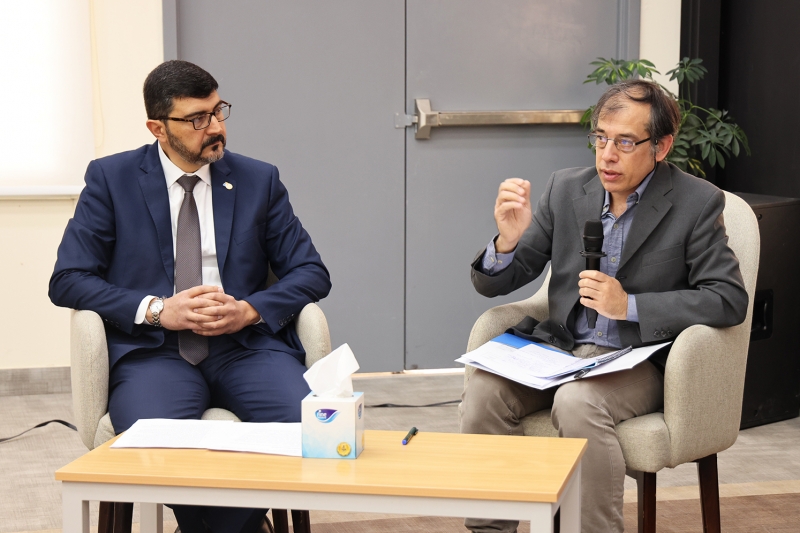
The German Jordanian University (GJU) organized a 'Key Stakeholders Meeting in the Water Sector', which was held by the School of Natural Resources Engineering and Management (SNREM). The meeting focused on sustainable water management, capacity building in Jordan’s water sector, and discussed the current state of education and training, as well as identifying the skills required for workers in this vital sector.
The event was attended by the German Ambassador to Jordan, Bertram von Moltke, and the President of the University, Prof. Ala'aldeen Al-Halhouli.
In his speech, Prof. Al-Halhouli emphasized that the water challenges facing Jordan require a national response based on knowledge and long-term planning. He noted that the university places the highest priority on this sector as part of its developmental mission. He pointed out that the water crisis in the Kingdom goes beyond environmental concerns, affecting national security, economic development, and social justice. This, he stressed, necessitates the development of multidisciplinary national capacities capable of understanding the various dimensions of the crisis. He affirmed that education is the most powerful tool for driving this transformation by preparing leaders with both technical expertise and an understanding of the social and political contexts of water issues.
Ambassador von Moltke, in turn, stressed that the water crisis is one of the most pressing challenges facing the Kingdom, with per capita water availability ranging from only 50 to 60 cubic meters annually, compared to the global minimum threshold of 500 cubic meters. He explained that Jordan’s water scarcity is not a new phenomenon but a deeply rooted issue that poses a real threat and could lead to conflicts if not addressed through sustainable solutions and effective international cooperation.
He called for the development of a multidisciplinary academic program in the field of water, covering history, geology, legal, environmental, engineering, and social aspects. The goal is to prepare a generation of professionals capable of making well-informed decisions on strategic projects such as dam construction or well drilling. He also praised the ongoing partnership with the German Jordanian University in shaping this vision. He emphasized that water scarcity makes it one of the most valuable resources in Jordan, underscoring the importance of government policies that ensure equitable access and efficient distribution of water. Additionally, he commended the Jordanian government’s efforts in managing this vital issue.
The meeting included a panel discussion moderated by The Dean of the School, Dr. Qasem Abdelal, who played a central role in steering the conversation toward key issues in the water sector, such as the gap between academic education and labor market needs and the necessity of developing interdisciplinary educational programs. Dr. Abdelal emphasized the importance of building effective partnerships among universities, government entities, and research institutions to deliver practical and applicable solutions. Panelists included Dr. Marwan Al-Raggad from the Islamic Network on Water Resources Development and Management, Dr. Moayied Al-Sayyed, Director of the Center for Water, Environment, and Climate Change at the Royal Scientific Society, and Dr. Cornelius Sandhu from the University of Applied Sciences in Dresden, Germany. Together, they contributed valuable scientific insights and practical experiences that enriched the discussion and highlighted both the challenges and opportunities facing the water sector.
The event concluded with a specialized survey involving all attendees. The results were displayed in real-time and discussed interactively, paving the way for the drafting of practical recommendations to enhance education and training in line with the needs of the water sector in Jordan.
The event witnessed broad participation, including representatives from the public and private sectors, specialized engineering firms, civil society organizations, as well as a number of academics and researchers. This reflects the growing importance of this sector and the need for collaborative efforts to develop it.