

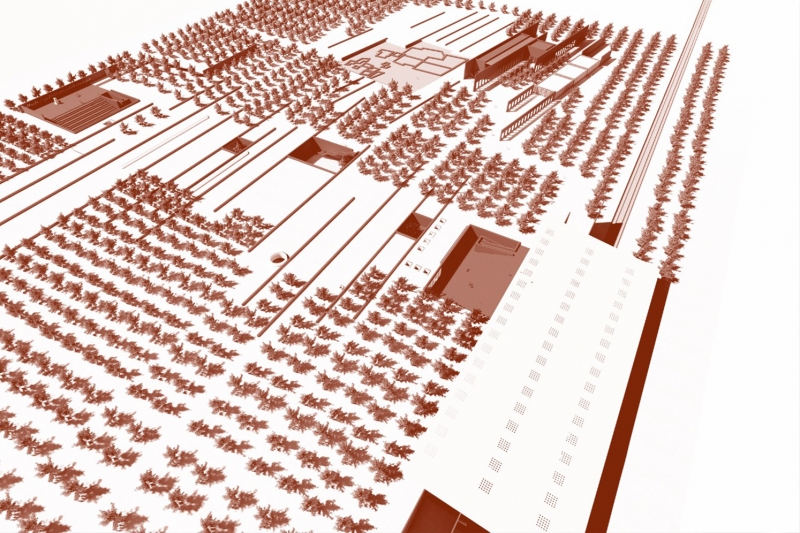
 The School of Architecture and Built Environment (SABE) at the German Jordanian University (GJU) won both second and third places in the ninth cycle of the International Competition for the Reconstruction of Destroyed Palestinian Villages, organized by the Palestine Land Authority in the UK. A total of 19 projects were submitted by students from various universities in Jordan and Palestine.
Graduate student Hala Amro, under the supervision of Eng. Leen Fakhoury, won second place, while fellow graduate Taima Al-Azab, supervised by Eng. Tha’er Qub’a, received third place. Both supervisors are practicing professors at the School of Architecture and Built Environment.
Regarding her award-winning project, Eng. Hala Amro explained that her design, titled "The Recovered Paths of the Khirab: Reviving Deir Sunayd", focuses on reviving the village of Deir Sunayd, which was demolished in 1948. Despite its destruction, the land still bears witness to life and resilience.
The project uncovers terraces, foundations, and spatial layers without disturbing the natural terrain, while introducing elevated walkways and restoring the old khan and train station as anchors of memory. It features five thematic paths, each narrating a different dimension of the village’s legacy—memory, daily life, culture, knowledge, and heritage. The journey culminates at the Observer’s Point, a symbolic space where absence is transformed into presence and a living identity.
As for Taima Al-Azab’s third-place project, titled "Al-Bayyara", it presents a compelling architectural vision for reviving the destroyed Palestinian village of Deir Sunayd. The design is anchored in three remaining historical landmarks: the railway line, the Egyptian Army memorial, and the old train station buildings. Through their transformation into the Gamal Abdel Nasser Museum, a marketplace, and a citrus orchard (Bayyara), the project reclaims the landscape as a site of memory and resilience. It envisions a future where absence is replaced by presence, and where collective memory is embodied in living architectural form.
Eng. Leen Fakhoury, reflecting on her supervision of the second-place project, commented: "This was my first experience supervising a graduation project focused on documenting the memory of devastated Palestinian villages and exploring the importance of sustaining that memory. We chose to approach the research from a broader perspective—one that examines the spatial reality of paths and events in Deir Sunayd within its wider regional context. This included analyzing social and economic connections, transportation networks, and the enduring resilience of both people and land, all with the aim of informing the project’s approach to revival and adaptive reuse."
Eng. Tha’er Qub’a also commented, emphasizing that merely participating in this competition is a significant achievement given the exceptional circumstances and the ongoing crisis in Gaza, which has lasted over 700 days. He affirmed that architecture can serve as a powerful tool for resistance and the preservation of identity. Regarding Taima’s project, Qub’a highlighted its importance in showcasing the Arab national dimension by connecting it to Deir Sunayd Village through a symbolic journey that begins at the train station, passes through the underground Nasser Museum, and culminates at Al-Bayyara, creating a rich architectural experience filled with symbolism.
It is worth noting that this marks the third time students from GJU have secured top positions in this competition, underscoring their excellence and prominent presence in local, regional, and international contests.