

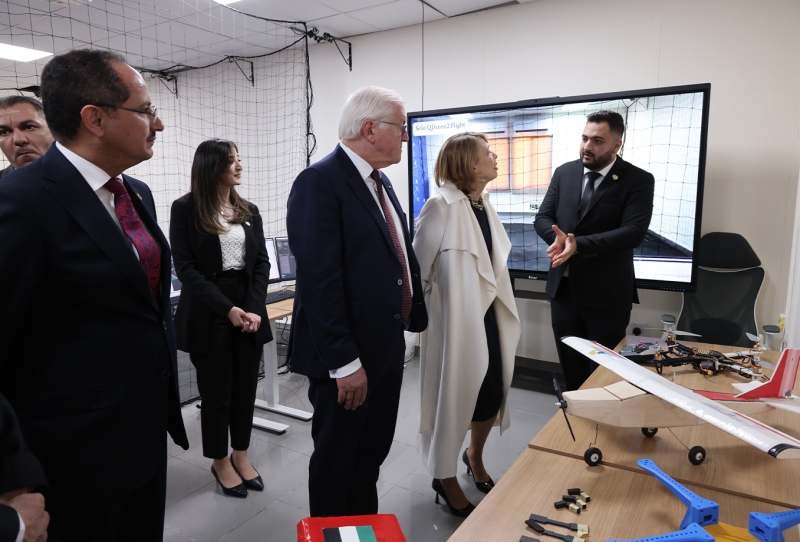
 During his visit to German Jordanian University (GJU) and its Technology, Research, and Innovation Complex, His Excellency the Frank-Walter Steinmeier, President of the Federal Republic of Germany, accompanied by the First Lady, reviewed the latest research projects and advanced applications at the Robotics and Intelligent Systems Laboratory. The visit reflected Germany’s strong commitment to supporting scientific research, fostering technological innovation, and strengthening academic collaboration with the university.
During the tour, Dr. Ghaith Al-Rifai delivered a specialized presentation highlighting the advanced technologies being developed at the laboratory. He shed light on the deployment of aerial robotics for crop monitoring and high-precision data analysis, supporting smart agriculture applications, enhancing productivity, and promoting environmental sustainability. The presentation also included a practical explanation of how robots operate using advanced sensors and integrated artificial intelligence systems embedded in both aerial and ground platforms. He explained how these technologies enable robots to perceive their surroundings, make decisions, and execute tasks efficiently across various applications, including agriculture, smart delivery, and industrial operations.
The visit featured a live demonstration of a ground robot powered by artificial intelligence for autonomous control and navigation. The robot showcased its ability to recognize its environment, plan paths, and make real-time motion decisions—demonstrating the advanced level achieved by the laboratory in developing autonomous systems.
President Steinmeier also reviewed an innovative research project presented by student Aws Tbeil, which focused on the use of drones in precision agriculture applications. The system enables real-time field data collection and processing, allowing farmers to optimize resource management, improve operational efficiency, and reduce costs. The project reflects the advanced level attained by the university’s students in developing practical, impact-driven technological solutions.
The presentation also highlighted collaboration with the German side, including a donation by Quantum-Systems GmbH of a specialized agricultural drone used for aerial surveying and data analysis to support smart farming solutions. Emphasis was placed on the importance of sustaining such cooperation to enrich scientific research and advance applications in robotics and artificial intelligence—reflecting the depth of the academic and technological partnership between the two sides.
This visit underscores the leading position of GJU as a regional hub for research and innovation, and its role in developing advanced technological solutions that serve vital sectors—foremost among them agriculture. It also reflects the strength of academic and technical cooperation between Jordan and Germany, opening new horizons for enhanced partnerships in artificial intelligence, autonomous systems, and future technologies.