
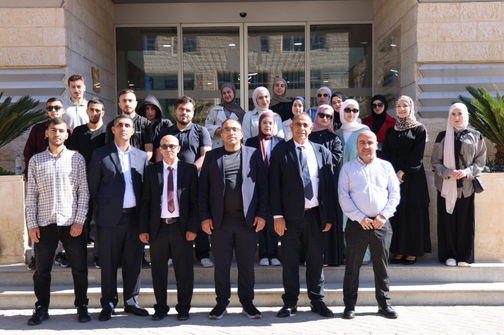
 German Jordanian University (GJU) and Palestine Technical University – Kadoorie (PTUK) have launched the International Summer School on Data Science, Machine Learning, and Artificial Intelligence, hosted at German Jordanian University in Amman from Monday through June 8, bringing together a distinguished group of scientists, academics, and experts from leading international universities and research institutions.
The summer school was inaugurated under the patronage of Prof. Ala’adeen Al-Halhouli, President of GJU, Prof. Hussein Shanak, President of Palestine Technical University – Kadoorie (PTUK), and Prof. Ayman Sobh, President of Al-Aqsa University in Gaza. The event reflects the depth of academic cooperation among the participating universities and their shared commitment to supporting high-quality scientific initiatives that create new opportunities for students and young researchers in advanced technologies and artificial intelligence.
The opening ceremony was attended by representatives of several international academic and scientific organizations, including COMSTECH, Physics Without Frontiers, University of Cambridge, Science for Palestine, and Weill Cornell Medicine – Qatar, in addition to representatives of the organizing universities, academics, researchers, and participating students.
According to a university statement issued today, this strong international presence underscores the significance of the initiative and its growing role as an advanced platform for academic collaboration and capacity building across the region.
The summer school targets university students, recent graduates, and early-career researchers from scientific, engineering, and computing disciplines through an intensive week-long training program that combines advanced theoretical lectures, practical applications, and collaborative projects. Participants will gain hands-on experience in designing and developing intelligent models, analyzing data, and applying artificial intelligence techniques to real-world challenges.
The program features contributions from prominent international academics and experts, offering participants a unique opportunity to engage directly with advanced research and educational experiences while exploring the latest global trends in data science, machine learning, and artificial intelligence.
The program is coordinated and implemented by leading academics, including Prof. Kamel Jabreen of Palestine Technical University – Kadoorie and Prof. Anas Attiya of GJU.
The curriculum covers a wide range of specialized topics, including supervised learning, unsupervised learning, deep learning, artificial neural networks, feature selection techniques, data analysis, and the use of globally recognized software tools for developing machine-learning models.
The program also emphasizes practical applications of artificial intelligence in strategic sectors such as healthcare, bioinformatics, economics, and climate resilience, enhancing participants’ ability to leverage modern technologies to address development challenges and improve quality of life.
This initiative represents an advanced model of academic cooperation between Palestinian and Jordanian universities, aiming to build a regional and international scientific network that connects young researchers with global research institutions and promotes joint projects in artificial intelligence, data science, and emerging technologies.
Organizers emphasized that the summer school extends beyond academic training to foster digital and research skills, strengthen a culture of innovation, teamwork, and scientific thinking, and help prepare a new generation of professionals capable of competing in the global digital economy.
The international partnerships supporting the summer school reflect its growing scientific reputation and the strong engagement it has received from leading academic and research institutions, alongside other scientific and development organizations.
The summer school is regarded as one of the region’s most prominent specialized academic initiatives in 2026, offering an advanced international learning environment, high-quality training opportunities, and a direct contribution to preparing a new generation of researchers and innovators in artificial intelligence and machine learning—fields that have become key drivers of digital transformation and sustainable development worldwide.