

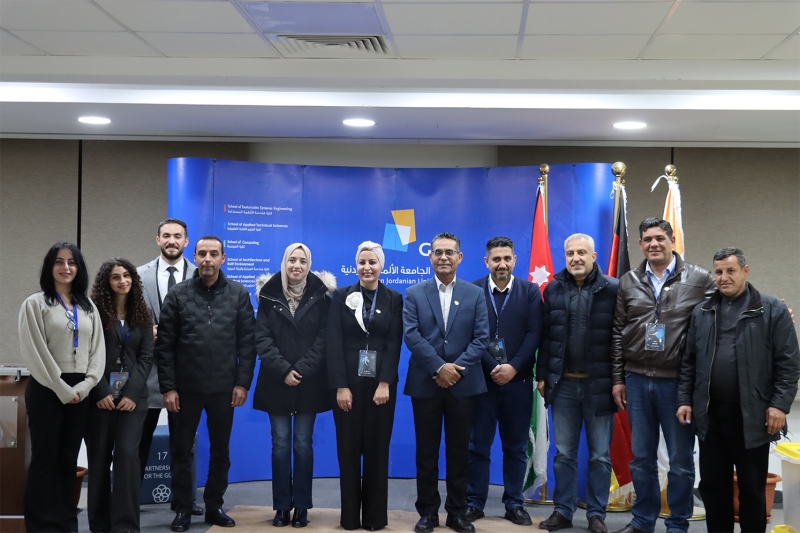
 The Dean of Student Affairs and Chair of the Higher Committee for Student Parliament Elections at GJU, Dr. Farah Al-Atrash, announced the preliminary results of the 2026 student parliament elections, which were conducted in a democratic and well-organized environment marked by transparency, integrity, and a strong spirit of fair competition.
These elections are considered the first student elections held across Jordanian universities in 2026, reflecting the university’s leading role in promoting democratic practices and encouraging active student engagement.
Voter turnout reached approximately 40% of eligible students, indicating a high level of awareness and commitment among students to participate in university life and decision-making processes.
The elections featured competition between two university-wide lists comprising 15 candidates, in addition to 33 candidates running at the faculty level across 8 electoral districts, highlighting the diversity of representation and broad participation.
Female students demonstrated a strong and notable presence, both in candidacy and in winning seats, underscoring their growing role and impact in student leadership and campus life.
The Higher Committee confirmed that the electoral process was conducted smoothly, with no significant irregularities affecting its integrity, supported by the university administration and in cooperation with relevant bodies, including the Independent Election Commission.
The results showed that 19 students were elected at the faculty level, while 9 seats were allocated to the lists—5 seats for the “Youth Accord” list and 4 seats for the “Awareness” list.
Dr. Al-Atrash emphasized that these elections represent an advanced model of conscious democratic practice within the university, reflecting students’ maturity and belief in their role in shaping decisions.
She also praised the active participation of female students, highlighting the university’s ongoing commitment to supporting initiatives that promote balanced participation and student leadership.
The committee expressed its appreciation to the Deanship of Student Affairs (DSA), the organizing committees, academic and administrative staff, and all participating students for their commitment to fair competition and democratic values.
The elections mark an important step in preparing capable student leaders who can represent their peers and contribute to fostering a culture of participation and responsibility.
Final results will be officially announced following the completion of the required legal procedures.
Election Statistics
1- Faculty-Level Elections
A total of 33 candidates ran at the faculty level.
Candidates were distributed across 8 electoral districts representing the university’s various faculties.
They competed for 19 seats allocated to faculty-level elections.
2- University-Level Lists
Two electoral lists competed at the university level.
The total number of candidates across the lists reached 15.
The two lists competed for 9 seats designated for university-level representation.
3- Total Number of Candidates
The total number of candidates in the student parliament elections reached 48.
This includes 33 candidates at the faculty level and 15 candidates at the list level.
4- Female Participation
A total of 21 female candidates participated in the elections.
10 female candidates won seats across various districts and lists.
This reflects a strong and active presence of female students in the electoral process, both in terms of candidacy and electoral success.