

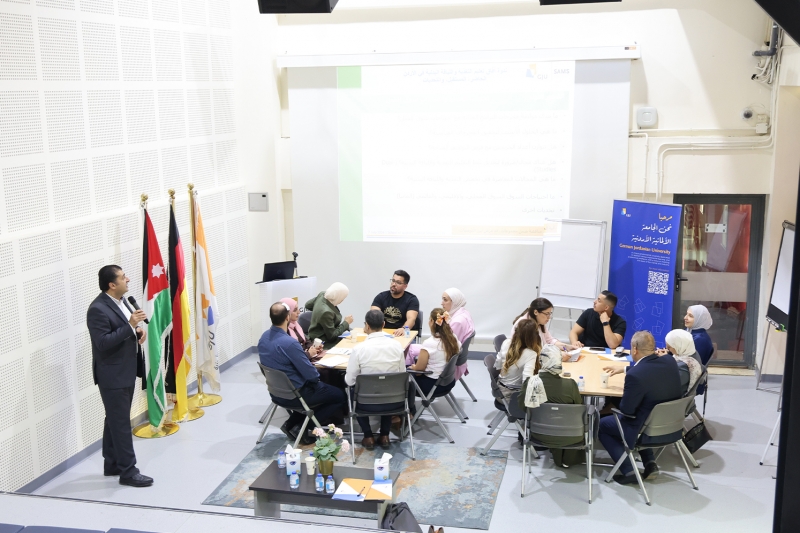
 The School of Applied Medical Sciences (SAMS) at the German Jordanian University (GJU) hosted a specialized workshop on Tuesday, July 7, 2026, at the University's Jabal Amman campus, titled "The Future of Nutrition and Fitness Education in Jordan: Current Status, Challenges, and Prospects."
The event brought together approximately 30 experts and representatives from Jordanian public and private universities, hospital nutrition departments, nutrition centers, fitness clubs and sports centers, as well as professionals from related sectors.
The workshop was inaugurated by the Vice President for Academic Excellence, Prof. Dr. Iyas Khader, who welcomed the participants and provided an overview of GJU and its practice-oriented academic model. He emphasized the importance of engaging stakeholders and professional bodies when considering the introduction of new academic programs to ensure their alignment with labor market needs while strengthening their academic quality, professional relevance, and long-term sustainability. He also expressed the University's appreciation to all participants for their valuable contributions and active engagement throughout the workshop.
The Dean of SAMS, Dr. Ziad Abu El-Rub, introduced the School and its academic programs in Biomedical Engineering, Pharmaceutical Engineering, and Chemical Engineering. He highlighted the School's emphasis on applied education, hands-on training, and leveraging the University's German dimension. He further stressed the importance of gathering feedback from experts and sector representatives to refine the initial proposal for a Bachelor's program in Nutrition and Fitness, define its academic and professional identity, and establish its added value.
The workshop featured three main thematic sessions focusing on assessing the current landscape and shaping future directions. The first session examined the challenges facing the nutrition and fitness sectors, the alignment of university graduates' competencies with labor market demands, and emerging career opportunities at the local, regional, and international levels.
The second session focused on accreditation requirements, curriculum design, core areas of knowledge, academic staffing, and practical and clinical training. The third session addressed the requirements for establishing the proposed program, including human resources, laboratories and equipment, infrastructure, training partnerships, and preliminary cost estimates.
Participants engaged in extensive discussions on the identity of the proposed program, the competencies expected of graduates, professional licensing requirements, achieving an appropriate balance between nutrition and fitness components, the importance of building sustainable partnerships with training and employment providers, and bridging the gap between theoretical education and practical application.
The workshop concluded with a discussion of preliminary recommendations, emphasizing the importance of completing a comprehensive needs assessment for the proposed program, reviewing the draft study plan, verifying accreditation and licensing requirements, and identifying training and employment opportunities for future graduates.
These recommendations will contribute to the development of a comprehensive academic and professional framework to be submitted to the University's relevant authorities for consideration.
Participants also stressed the importance of strengthening sustainable collaboration between Jordanian universities and the medical and sports sectors, as well as continuously updating academic curricula to equip the local labor market with highly qualified graduates capable of enhancing the quality of professional practice in Jordan.