

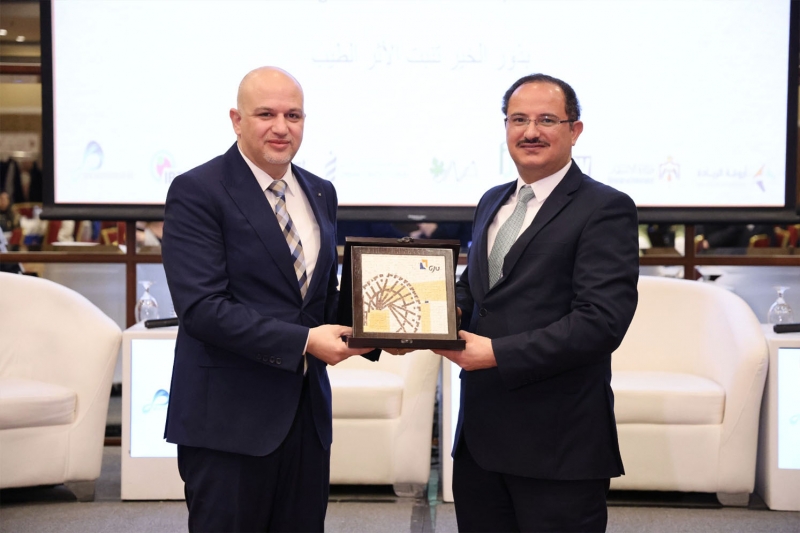
The German Jordanian University (GJU) officially launched the "Doing Good, Growing Strong" project under the patronage of the Minister of Investment, Eng. Mothanna Gharaibeh, with the participation of approximately 110 attendees, including more than 40 social impact creators. The project is led by Principal Investigator Dr. Farah Al-Taji, an assistant professor in Entrepreneurship and Strategy at Brunel University of London, and is implemented in partnership with GJU and Lund University in Sweden. The project is funded by the British Academy. This two-year project aims to develop a sustainable and comprehensive ecosystem for growing social enterprises in Jordan.
During the launch event, Eng. Gharaibeh emphasized the need to support sustainable initiatives that contribute to the national economy. He highlighted the importance of simplifying legal procedures to facilitate the establishment of social enterprises and stressed that collaboration between the government, private sector, and civil society is essential for achieving sustainable development.
GJU President, Prof. Alaaldeen Al-Halhouli, described the project as a pivotal step in building a national entrepreneurial ecosystem based on solidarity and strategic partnerships. He also noted that integrating the project into the Catalyst Now network strengthens its regional and global presence, enabling access to international expertise in social entrepreneurship.
Dr. Abdelrahman Zuraik, President’s Advisor for Innovation, Technology Transfer & Entrepreneurship at GJU, underscored the project’s role in supporting social entrepreneurs and transforming their ideas into successful ventures. He also announced the launch of the Social Entrepreneurship Hub (SEH), which will serve as an incubator for changemakers. Additionally, he highlighted GJU’s commitment to applied innovation through its Technology, Research, and Innovation Park (TRIP), which develops solutions tailored to community needs.
Dr. Farah Al-Taji, Principal Investigator of the project from Brunel University London, provided an overview of the project’s objectives. She emphasized its mission to build an ecosystem led by grassroots initiatives, supported by relevant stakeholders, and strengthened through effective partnerships across different sectors. The approach integrates both bottom-up and top-down strategies to ensure inclusivity and impact. The project focuses on financially sustainable social enterprise models that create social impact without relying on external donations. She also highlighted the importance of exchanging experiences with regional models to foster innovation and shared learning.
Strategic Collaborations
While Brunel University of London is the project lead and GJU and Lund University are the primary academic partners, the project also collaborates with several strategic partners from Jordan and beyond. These include:
- Nationally: IBTECAR, Jordan Strategy Forum, Impact Jordan, Jordan Nature Academy, and the Ministry of Investment
- Regionally: Arwaqah Alreyadah (Saudi Arabia) and COSV (Lebanon)
- Internationally: Catalyst Now (MENA Chapter coordinated by Ghufran Abu Dayyeh)
Panel Discussions and Key Contributions
The event featured panel discussions under the theme "Doing Good in Jordan and the Arab World", addressing challenges and opportunities in Jordan and showcasing successful social innovation models both locally and regionally.
Between the two panel discussions, Prof. Rana Al-Dajani contributed virtually, sharing insights on the role of social entrepreneurship in addressing regional challenges and driving sustainable impact.
The first panel included:
- H.E. MP Rakeen Abu Haniya
- Mrs. Eman Abida, Founder of Jordan Nature Academy
- H.E. Nesreen Barakat, CEO of the Jordan Strategy Forum
The second panel featured:
- Eng. Moatamed Baqis, Founder & CEO of Arwaqah Alreyadah, Saudi Arabia
- Dr. Mohammed Makki, COSV Lebanon
Believing in the power of social entrepreneurs and their role in leading the ecosystem development, Mr. Rabee Zureikat, Co-Founder of Al-Barakeh Wheat, was invited to share his experience in creating a sustainable and community-driven social enterprise in Jordan. His initiative, which focuses on planting and harvesting wheat in Jordan, serves as an outstanding model of local social innovation. As a symbolic gesture, each participant received a 1kg pack of Jordanian wheat, emphasizing the importance of self-sufficiency and productivity in the impact social enterprises create.
Workshop on Social Entrepreneurship
At the conclusion of the event, Arwaqah Alreyadah conducted a "Needs Assessment" workshop, aimed at analyzing key challenges and identifying potential solutions to further strengthen the social entrepreneurship ecosystem in Jordan.