
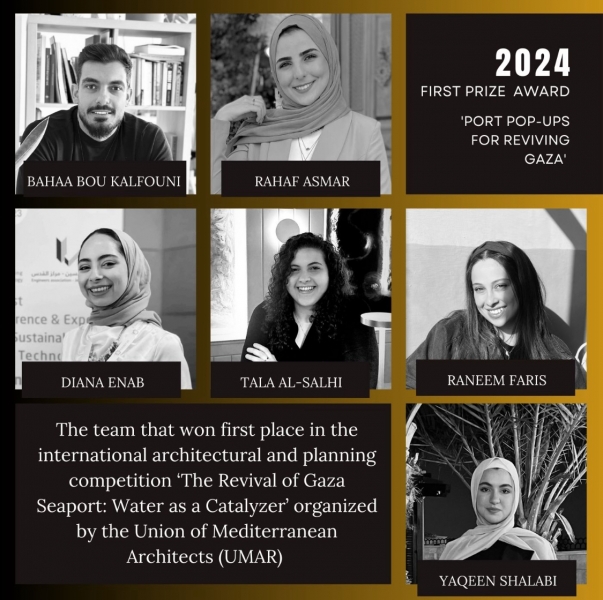
Yaqeen Shalabi, a student from the School of Architecture and Built Environment (SABE) at the German Jordanian University (GJU), and her team, which includes participants from Palestine, Jordan, and Lebanon, won the International Architecture and Planning Competition organized by the Union of Mediterranean Architects (UMAR) under the theme "Reviving Gaza Port: Water as a Catalyst."
The competition took place as part of a summer school hosted at the GJU campus in Jabal Amman. It provided an opportunity for emerging designers and architects from across the region to showcase their talents and engage with their communities within a Mediterranean knowledge exchange agenda.
The team presented a vision titled "Reviving Gaza Port through Temporary Stations," led by planner Baha Boukalfouni from the School of Architecture at Gdansk University of Technology, with the participation of his team members from different universities: Dr. Diana Anab from An-Najah National University, Eng. Yaqeen Al-Shalabi from GJU, Eng. Talaa Al-Salhi from the University of Jordan, Eng. Raneem Fares from Birzeit University, and Urban Planner Rahaf Asmar from Sapienza University of Rome.
The team proposed a flexible urban plan that addresses short, medium, and long-term needs, based on human-centered design strategies, encouraging local communities to adapt through multiple stages of design intervention. The vision focused on Gaza Port as a catalyst, not only as a physical space but also as a cultural, historical, and economic element that contributes to the sustainability of the community. The team believes that this plan will grow organically from the port, which remains one of the few open spaces where people gather, and expand toward the city to find solutions for reconstruction and development.
To translate this vision, the team designed four small urban programs within an integrated urban fabric, inspired by the motto "The sea completes the land, and the land completes the sea," highlighting the complementary relationship between the two elements. These programs extend along an urban axis connecting the port to the city center of Gaza, taking into account the extent of damage to the urban areas (partial, total, or none) in order to provide emergency housing and workplaces.
The urban programs rely on support from non-governmental organizations working in key sectors, including the revival of fishing practices, promoting sustainable agriculture, preserving cultural identity, and providing educational opportunities—all contributing to empowering the local community and enhancing its resilience in the face of challenges.