
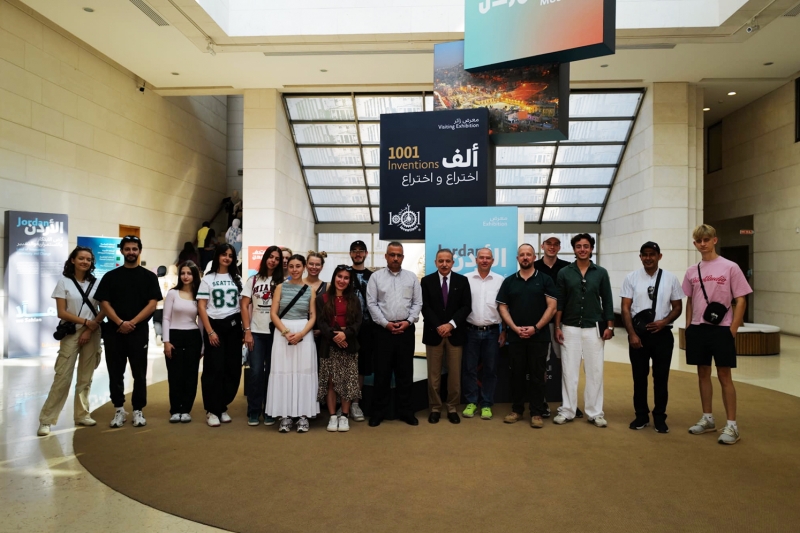
 The German Jordanian University (GJU), through the School of Architecture and Built Environment (SABE), successfully hosted the DAAD-funded Project Week “Digitalization of Cultural Heritage” from 25 to 30 October 2025. The event brought together over 40 participants, including students, lecturers, and experts from Germany and Jordan, for a week of interdisciplinary collaboration, fieldwork, and cultural exchange.
This international teaching initiative is led by Prof. Julia Schnitzer from Technische Hochschule Brandenburg (THB), in partnership with Prof. Paul Grimm from Darmstadt University of Applied Sciences (h_da). Industrial Prof. Mohammad Alnusairat represented GJU as the host and project coordinator in Jordan. The workshop also benefited from the organizational support of Anika Kettelhake and Sebastián López Castellanos, who are part of the ELI-Incubator—a component of the DAAD’s UAS.International program, which promotes globally oriented teaching formats and supports collaboration between universities of applied sciences worldwide.
This year, the project expanded to include The Jordan Museum as a key partner. Under the guidance of Dr. Yosha Alamri, Senior Curator, students were granted access to selected artifacts to document them using 3D scanning, photogrammetry, imaging techniques, and interactive media. Nine students from GJU’s Design and Visual Communication Department joined their peers from THB and h_da to work in international teams, developing 3D models, interactive prototypes, and digital storytelling concepts aimed at enriching the museum’s digital archive. Reflecting on the collaboration, Prof. Julia Schnitzer said: “This project offers students a unique chance to explore Jordan’s rich cultural heritage and transform it into engaging digital experiences. We are grateful for the warm support of The Jordan Museum and the German Jordanian University, whose hospitality and cooperation make this work possible.” The week also included cultural excursions to the Dead Sea, Wadi Rum, and Petra, reinforcing the students’ understanding of the heritage they are documenting. The project work will continue throughout the winter semester, with the final outputs shared with The Jordan Museum for further use.
This workshop reflects GJU’s ongoing commitment to fostering international collaboration, innovation, and practical learning opportunities for students, particularly in areas that connect design, technology, and cultural preservation. For more information about the DoCH project, please visit the official platform: www.pih.education