
Creativity in Teaching German as a Foreign Language – The GFL Classroom as a Living Learning Space
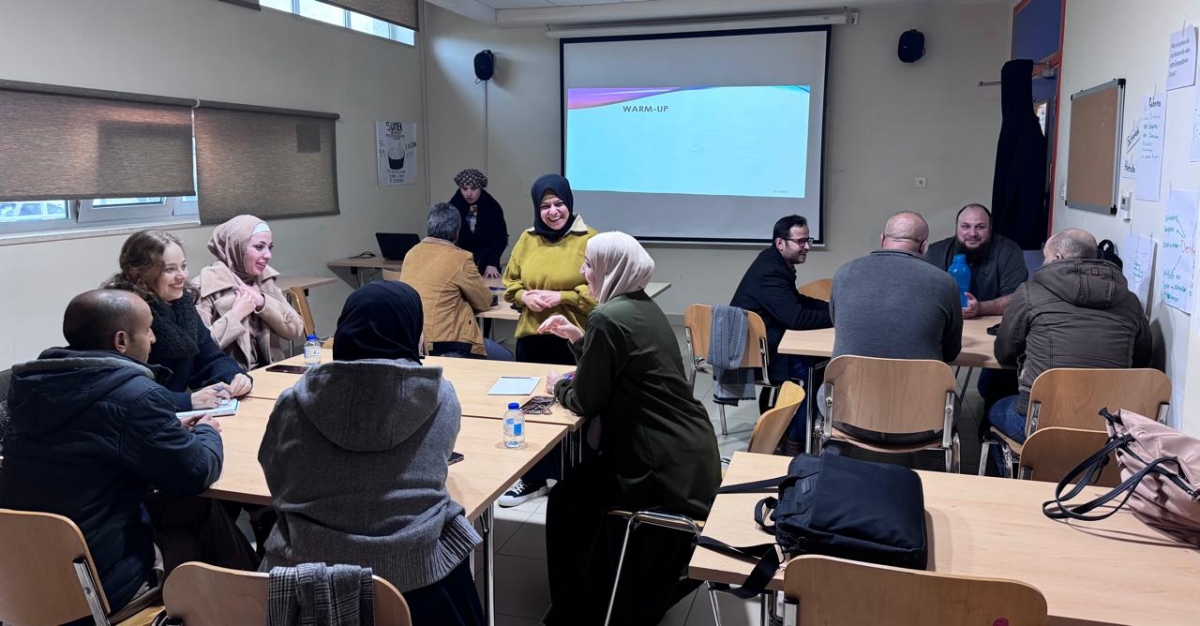
Teaching German as a Foreign Language (GFL) is far more than the transmission of grammar and vocabulary. It is a social, creative, and dynamic learning space in which language is experienced, explored, and collaboratively constructed. Against this background, the German Language Centre (GLC), in cooperation with GFL lecturer Elaf Al-Najafi, organized an interactive workshop on 15 December 2025 entitled “The GFL Classroom as a Living Learning Space.” The workshop was specifically designed for teaching staff and placed strong emphasis on professional exchange and collaborative reflection. Over the course of approximately 80–90 minutes, participants explored hands-on teaching methods, reflected on their own classroom experiences, and developed new ideas for a motivating and effective GFL classroom.
Creativity as a Driver of Language Production
The main objective of the workshop was to consciously use creativity as a driver of language production. The focus was on methods that encourage learners to speak and write, reduce inhibitions, and create authentic communicative situations. It became clear that creative approaches not only enhance student motivation but also have a lasting positive impact on the overall learning atmosphere.
The workshop was deliberately designed to be highly interactive, combining short theoretical input with practical activities in individual work, group work, and plenary sessions. Participants were not merely observers but actively engaged in the activities, experiencing the methods from the learners’ perspective.
Storytelling as a Language Engine
The workshop began with a creative warm-up activity using the “One Word Story” method. Working in small groups, participants collaboratively developed a story, with each person contributing only one word at a time. This simple yet effective activity helped to create an open atmosphere, foster spontaneity, and reduce potential speaking anxiety. In the subsequent discussion, participants reflected on their experience and explored ways of adapting the method to different proficiency levels. Particular emphasis was placed on the playful nature of the activity, which strengthens group dynamics and encourages learners to speak without performance pressure.
A central component of the workshop was storytelling as a didactic tool. Using story cubes, visual prompts, and creative writing tasks, participants were introduced to various ways of employing stories to promote both oral and written language production. The methods presented included the five-sentence story with fixed sentence starters and collaborative writing, in which several learners jointly create a text.
These approaches are suitable for both face-to-face teaching and digital learning environments and can be flexibly implemented using tools such as Padlet, Google Docs, or Miro. Practical experimentation demonstrated that collaborative storytelling and writing not only enhance linguistic competence but also foster creativity, cooperation, and enjoyment in learning.
Creative Use of Authentic Materials
Another key focus of the workshop was the creative use of authentic materials. A wide range of examples from students’ everyday lives were presented, including podcasts, interviews, Instagram Reels, anime scenes, TV series, artworks, memes, and comics.
Participants discussed how such materials can be meaningfully integrated into GFL instruction to provide variety and address different learning styles. Methods such as perspective shifts, continuing a scene, creating original memes, or adding voice recordings to images offer innovative approaches to language learning and promote authentic communication. Particular emphasis was placed on the fact that authentic materials increase the relevance of learning content and actively engage learners in the learning process.
Unconventional Speaking Activities for Enhanced Communication
The workshop concluded with the presentation of unconventional speaking activities designed to encourage learners to speak without relying on traditional discussion formats. These included role reversal, future scenarios, improvisational dialogues, mini-debates, and collaborative storytelling. Such methods demonstrate how communicative competence can be developed in creative and enjoyable ways, empowering learners to use language actively and confidently.
Reflection and Professional Exchange
The final reflection phase focused on transferring the workshop content into participants’ own teaching practice and fostering professional exchange. Participants reflected on which methods they intended to implement immediately in their classrooms and collaboratively compiled a collection of useful tools and resources.
The workshop highlighted the value of collegial exchange and the shared development of innovative teaching ideas. Through professional development initiatives such as this, the GLC – German Language Centre continues to promote innovative, learner-centered, and contemporary approaches to GFL teaching at the German-Jordanian University.