
Introduction
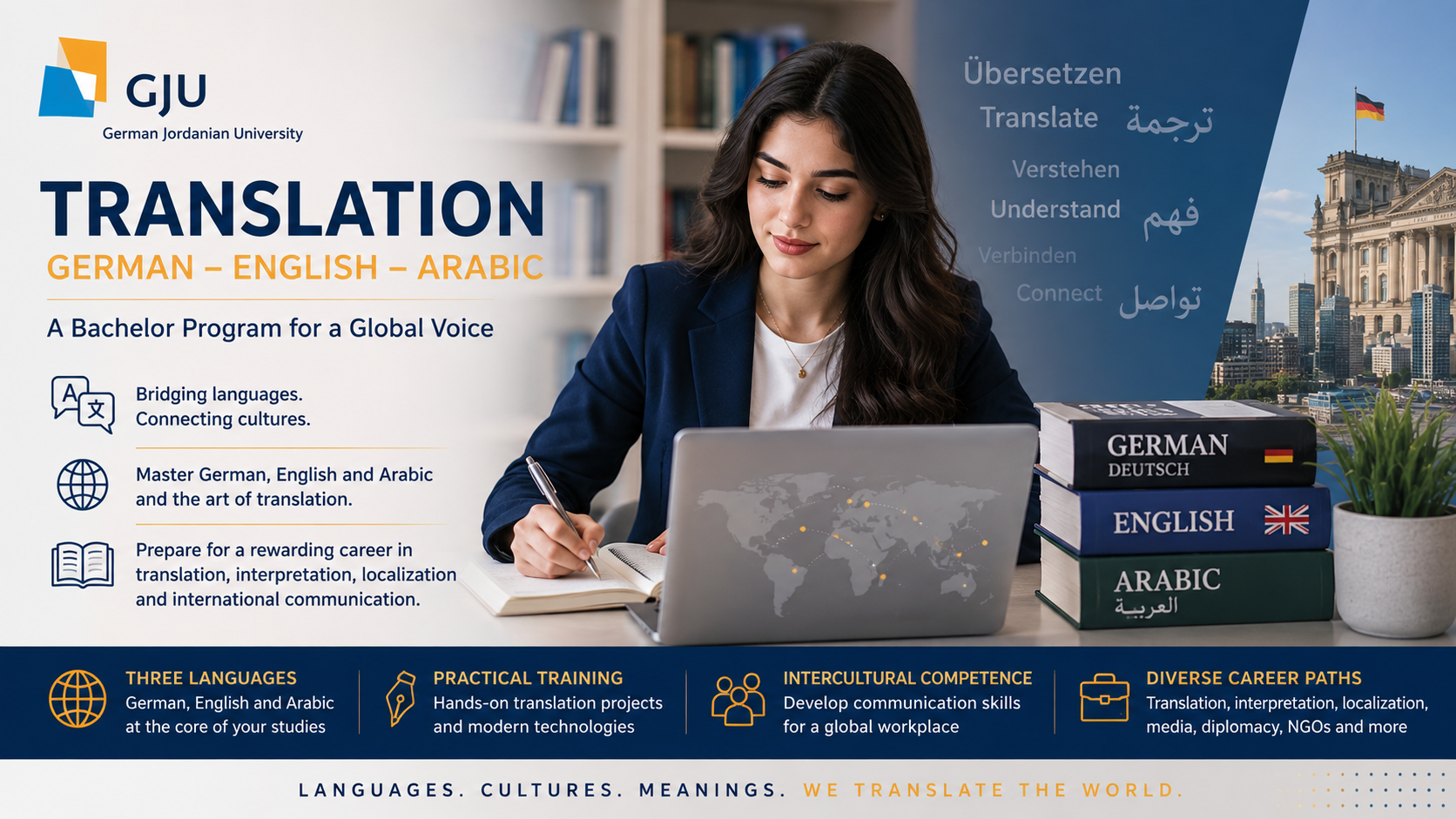
The B.A. "Translation: German, English, Arabic” Program was established in September 2007. The program is unique in the region and even worldwide with its equal focus on three languages at the same competence level. Students usually, but not exclusively, start the program with Arabic as their native language and a good command of English.
In the first two years of their studies, the students focus on consolidating their first and second language skills and acquiring German as their third language. In addition, they are introduced to the basic principles of translation as well as crucial aspects of linguistics and culture studies. In the third year, the students delve deeper into the world of translation while translating texts from a wide range of fields between all three languages and exploring specific challenges in translating between cultures. Like GJU students of other majors, students of the Translation program spend the fourth year of their studies in Germany, studying for one semester at one of the renowned partner universities and doing an internship at a company of their choice during the second semester. The students generally experience this German year as truly life-changing. It provides them with deeper insights into the German culture and the practical dimension of doing an internship abroad and, within the context of one of the most flourishing economies of the world, the internship profoundly increases their later career prospects.
Program Objectives
The program aims at graduating translators who have:
-
A high command of three working languages (German, English and Arabic);
-
Acquired theoretical knowledge and practical skills in translation;
-
Acquired knowledge in three fields of specialized translation;
-
Excellent cultural and intercultural communication skills with regard to their own culture and some cultures in which their working languages are used;
-
Gained insight into the German society, culture and working environment during one semester at a German university and a 20-week internship at a German company or organization.
Learning Outcomes
Program graduates will be able to:
-
Use their working languages confidently and in an appropriate way;
-
Translate various kinds of texts from various fields of knowledge;
-
Carry out translation tasks that go beyond the traditional tasks of a translator, such as subtitling etc.;
-
Make appropriate use of new information technologies and translation tools;
-
Use different kinds of references properly (dictionaries, parallel texts, online information sources etc.);
-
Communicate appropriately within their own culture as well as between different cultures;
-
Take on responsibility and work both individually and in teams;
-
Identify problems and find ways of solving them;
-
Adapt quickly to new tasks and new fields;
-
Work on both the national and international levels.
Target group:
The program targets school graduates who wish to further their higher education – first academic degree – in the field of translation and languages, namely English, German and Arabic. Prior knowledge of German is not a must since the program provides the students with German courses from the very basics where most of the courses are taught in Arabic, English, and German.
Employment and Career Prospects
As a result of the professional upscale training and experience in the field of translation acquired in the program, skilled students are in high demand in the labor market. Besides the professional perspective, there is also the possibility for graduates to continue their studies in an M.A. program at German Jordanian University – for instance, the M.A. program in German as a Foreign Language – or at another university. Since translations are needed in all fields of human communication, graduates of the Translation program work in a wide variety of fields, for example:
-
as translation freelancers or in translation and subtitling companies;
-
in embassies;
-
in NGOs;
-
in German organizations in Jordan or in other Arab countries;
-
in theatres, museums, and tourism (cultural work);
-
in publishing houses, libraries, and book-stores (editorial work);
-
in newspapers, radio, television;
-
in language institutes, universities;
-
in any area that requires language and cultural experts who can translate, negotiate, and mediate in creative ways between different cultural contexts; this is particularly valid for companies that cooperate with the German and English speaking world.
For many graduates, the extensive language skills they have acquired in the course of their studies opens up a good number of opportunities for continuing their studies in a more or less related field abroad.
Applied Translation Track