
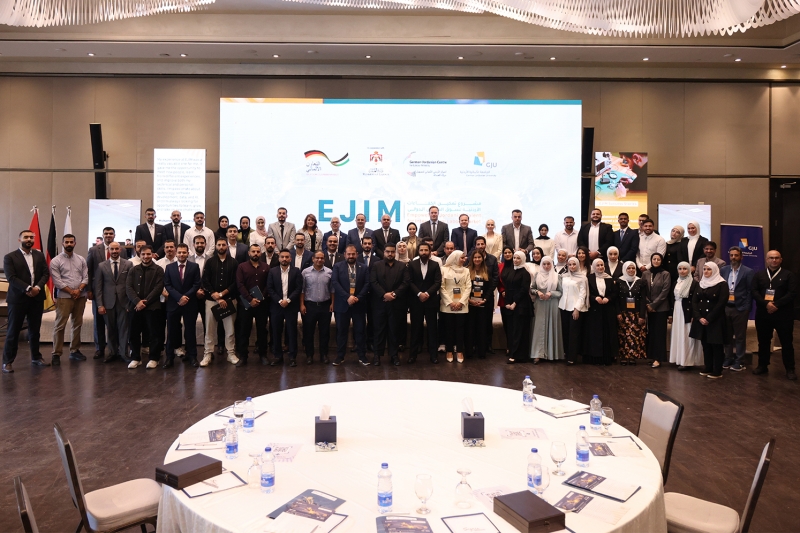
 The German Jordanian University (GJU) celebrated on Saturday, 10 October 2026, the graduation of 72 participants from the Empowering Jordanian Individuals for the International Labour Market (EJIM) project, marking the conclusion of the project’s activities. The ceremony was attended by Dr. Abdelhalim Doujan, Secretary-General of the Ministry of Labour, representing the Minister of Labour, and Mr. Jonas Lukas, Development Counsellor at the German Embassy, alongside representatives of the German Agency for International Cooperation (GIZ), as well as project partners, employers, trainers, experts, and graduates.
Implemented by GJU with support from the German Federal Ministry for Economic Cooperation and Development (BMZ), in cooperation with GIZ and Jordanian and German partners, the EJIM project aims to enhance the readiness of Jordanian professionals to access employment opportunities in international markets. It does so by developing structured pathways that connect labour market needs with qualified talent, with a practical focus on the German labour market and the information technology and industrial engineering sectors.
In his remarks, GJU President Prof. Ala’aldin Al-Halhouli stated that EJIM reflects the University’s vision of serving as a platform that connects education with industry, talent with opportunities, and knowledge with economic and social impact. He noted that the project builds on GJU’s longstanding approach to strengthening integration with industry through its dual-study programmes, the Technology, Research and Innovation Park (TRIP), and the Deanship of Innovation and Technology Transfer (DI-TECH).
Prof. Al-Halhouli added that the challenge is no longer limited to preparing young people to seek employment; rather, it lies in building an integrated system capable of understanding labour market needs, developing relevant skills, connecting qualified professionals with employers, and fostering trust among all stakeholders. He also emphasised the importance of expanding Jordanian-German cooperation in the future to encompass talent development, innovation, industry, scientific research, digital work, and economic cooperation.
For his part, Dr. Abdelhalim Doujan conveyed the greetings of the Minister of Labour and highlighted the project’s role in preparing and promoting skilled and trained Jordanian professionals for international markets, particularly the German labour market. He noted that international labour markets increasingly seek professionals with the technical skills, qualifications, discipline, and language proficiency required for modern occupations.
Mr. Jonas Lukas, Development Counsellor at the German Embassy, highlighted EJIM as a practical model of Jordanian-German cooperation that brings together skills development, professional preparation, engagement with employers, and the establishment of more structured pathways for international labour mobility. He also stressed the importance of ensuring that successful projects leave a lasting legacy of accumulated knowledge, stronger partnerships, and institutional expertise and capacities that can be further developed in the future.
Dr. Ziad Abu El-Rub, the project’s Principal Investigator, explained that EJIM was founded on a fundamental principle: training programmes should be designed around actual labour market needs. Accordingly, the project worked with German experts and consultants to assess demand in the targeted sectors, identify the required skills, and align training and qualification programmes with these needs.
He explained that the project initially engaged more than 300 candidates, who underwent technical, language, and psychological assessments, as well as guidance on international labour mobility. Following this process, 92 candidates were selected to participate in a comprehensive preparation pathway covering technical skills development, job readiness, CV preparation, interview skills, preparation for working in multicultural environments, German-language training, and engagement with employers.
As part of the German-language training component, 64 participants enrolled in the A2-level course. Of these, 30 sat for the examination, and 21 successfully passed. Overall, 72 participants graduated from the project, with 59 attending the graduation ceremony.
Dr. Abu El-Rub noted that the project has already begun to demonstrate tangible impact, with several graduates securing professional opportunities in Jordan and abroad, including in Germany and Qatar. Other participants continue to take part in recruitment interviews and language training. He added that the project’s impact will continue to be assessed through a graduate-tracking study in the coming phase.
More than 70 local and international companies participated in the project’s activities, reflecting an approach that places early engagement with employers at the heart of the qualification process. This approach is based on the principle that labour mobility should begin with actual market demand, followed by identifying the required skills, assessing candidates, addressing skills gaps, and connecting qualified individuals with suitable opportunities.
The ceremony also witnessed the official launch of “Masar,” the Labour Mobility Platform, developed under the project to address fragmented information and provide guidance for individuals seeking international employment opportunities. The platform helps job seekers understand the relevant requirements, skills, language proficiency levels, and available pathways.
The project team emphasised that Masar is not limited to the German labour market. Rather, it has been designed as a foundation that can be further developed to support multiple labour mobility pathways in line with market needs, partnerships, and national priorities.
In a speech delivered on behalf of the graduates, their representative highlighted how the EJIM experience had contributed to developing their technical and professional skills, improving their ability to present themselves to employers, and strengthening their understanding of different workplace cultures. The representative also explained that training in CV preparation and job applications had opened doors to interviews with local and international companies.
The ceremony concluded with the recognition of project partners and supporting institutions, followed by the distribution of graduation certificates. Speakers affirmed that the conclusion of EJIM does not mark the end of its journey, but rather the beginning of a new phase in which the project’s success will be measured by the professional pathways its graduates build and the continued development of the institutions, partnerships, and initiatives established through the project.