
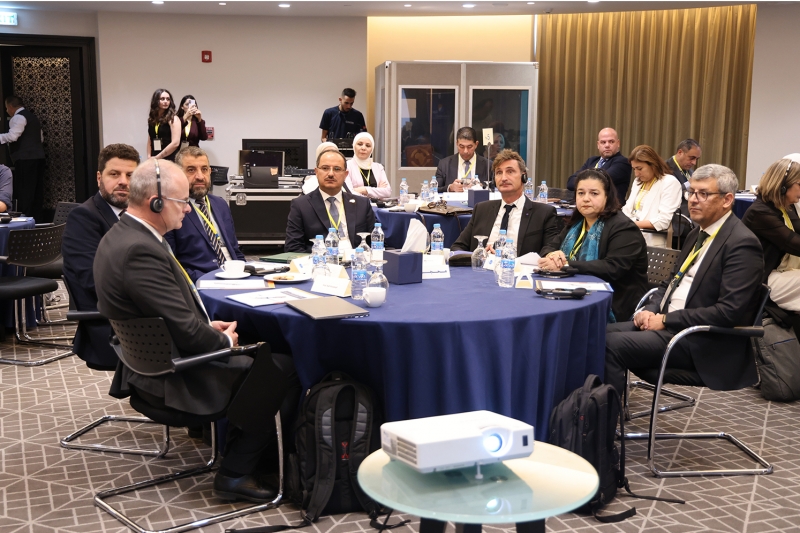
 The German Jordanian University (GJU), through the Syrian Innovation in Academia (SyrIA) project and with the support of the German Academic Exchange Service (DAAD), hosted the Third Jordanian–Syrian Dialogue Forum for Higher Education Development at Signia by Hilton in Amman.
Building on the previous Jordanian–Syrian higher education dialogues, the forum aimed to move from identifying institutional needs and challenges toward defining priorities, exploring funding and cooperation opportunities, and strengthening partnerships between universities, international partners and funding organizations to support the recovery, development and long-term sustainability of Syrian higher education.
The high-level event was attended by H.E. Dr. Ihsan Al-Rumman, Ambassador of the Syrian Arab Republic to the Hashemite Kingdom of Jordan, alongside representatives of higher education and scientific research institutions, international organizations, funding bodies and SyrIA project partners.
Representatives of the Supreme Syrian–Jordanian Business Council also attended the forum, including Mr. Nashat Al-Rifai, Secretary of the Council; Dr. Hussein Al-Manjar, Executive Director; and Mr. Mohammad Al-Istwani, contributing an important economic and professional dimension to discussions on future cooperation and the role of higher education in development.
The forum opened with welcoming remarks by Prof. Dr. Alaadeen Al Halhouli, President of the German Jordanian University; Dr. Hebatallah Fathy, Director of the DAAD Regional Office Amman; and Dr. Abdul Hamid Al-Khalid, Deputy Minister of Higher Education for Student Affairs in Syria.
In his presentation, “Syrian Higher Education in Transition,” Prof. Dr. Ralf Roßkopf, GJU Vice President for International Affairs and SyrIA Project Lead, presented key insights from the project and its fact-finding mission to eight Syrian universities. He emphasized that investment in higher education should not be viewed as a parallel track to recovery and reconstruction, but as a prerequisite for it, given the role universities play in educating professionals, generating knowledge, supporting public institutions and connecting regional needs with national recovery.
Roßkopf stressed that the fact-finding mission was not an evaluation or ranking of Syrian universities, but an effort to understand shared systemic challenges and their different regional manifestations. The findings pointed to a strong commitment to teaching, research and institutional development despite severe constraints. Common priorities identified by Syrian institutions included staff development, governance and project management, digital transformation, research internationalization and stronger links to the labour market, while physical and digital infrastructure remains an essential enabling condition for sustainable reform.
The session on Syrian Universities’ Development Needs, Priorities and Proposed Initiatives brought together the Syrian delegation comprising Dr. Abdul Hamid Al-Khalid; Prof. Dr. Nabil Kochaji, Director General of the Higher Commission for Scientific Research in Syria; Dr. Hanan Abu Hatab, Director of the International Cooperation Directorate at the Syrian Ministry of Higher Education and Scientific Research; Dr. Namir Abdul Karim Issa; and Dr. Omar Hamdi.
Prof. Dr. Nabil Kochaji presented key priorities, needs and proposed initiatives identified by Syrian higher education institutions. His presentation highlighted several interconnected areas, including academic and laboratory infrastructure, digital transformation and governance, human capacity development, innovation and entrepreneurship, labour-market linkages, and high-priority sectors such as health, agriculture and food security. The presentation stressed that academic infrastructure, laboratories and human-capacity development are essential foundations for sustainable institutional reform.
Dr. Hanan Abu Hatab also addressed the current realities of Syrian higher education and the key challenges facing the sector, highlighting the importance of understanding these challenges within their institutional and national context and of strengthening continued dialogue and cooperation with regional and international partners in response to the actual needs of Syrian universities.
The discussions further highlighted the connection between universities, society and national economic needs, including initiatives in health and rehabilitation, mental health, smart agriculture, food security, innovation and mechanisms linking research outcomes with local economies. The presentation summarized national needs around four overarching areas: safe and modern university infrastructure, comprehensive digital transformation, sustainable human-capacity development, and stronger connections between universities, innovation, the labour market and priority national sectors.
The programme continued with a discussion chaired by Prof. Dr. Ala’a Khalifa, Subproject Leader of the SyrIA Dialogue Events, on aligning proposed initiatives with available funding opportunities. During the session, Dr. Hebatallah Fathy presented DAAD funding opportunities, followed by a discussion on pathways for cooperation and support and on translating identified priorities into feasible projects and partnerships.
The day concluded with closing remarks by Prof. Dr. Dhia’a Abu Tair, SyrIA Project Co-Leader/Manager, emphasizing the importance of building on the outcomes of the dialogue and translating evidence and Syrian-defined institutional priorities into sustainable partnerships and future initiatives.
Through its combination of evidence-based analysis, capacity development and structured policy dialogue, SyrIA seeks to move from identifying priorities toward building sustainable academic partnerships and initiatives shaped by the needs and priorities identified by Syrian higher education institutions themselves.