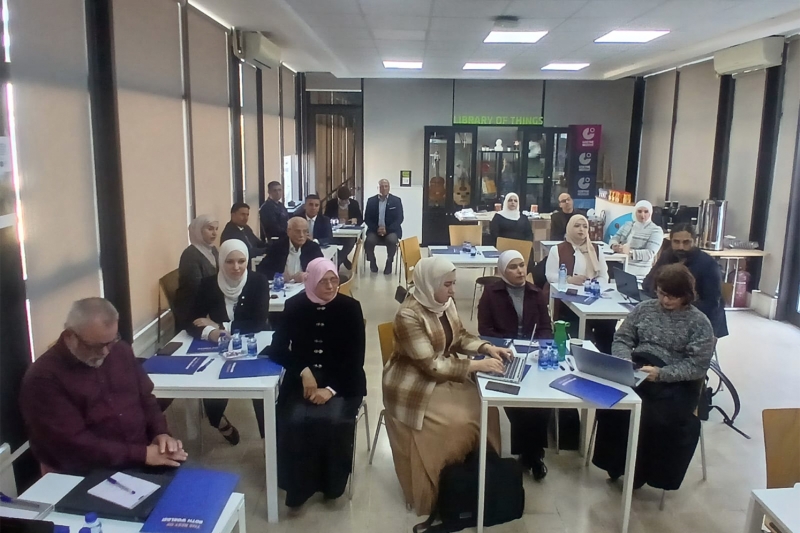
 The German Jordanian University (GJU), in cooperation with Brandenburg University of Technology Cottbus-Senftenberg (BTU) and with support from the German Academic Exchange Service (DAAD), organized an expanded meeting for stakeholders and relevant entities in the Kingdom’s geopark sector. The meeting was Held as part of the project "Establishing a Regional Working Group to Link the UNESCO Chair 'Digitisation of Cultural Heritage' with the Middle East Region – UNESCO Global Geoparks Initiative," the gathering brought together a distinguished group of international and local experts.
The meeting hosted international expert Dr. Gösta Hoffmann, Head of the UNESCO Global Geoparks and International Geoscience Programme (IGCP) Unit in the Federal Republic of Germany, alongside a delegation of experts and specialists from Leipzig University in Germany, as well as Professor Iain Stewart, Professor of Geoscience Communication at the University of Plymouth in the UK. Their participation provided an opportunity to exchange international expertise and explore ways to develop the vital sector in Jordan and the wider region.
The meeting was held as part of the university’s German Week 2026 activities, bringing together representatives of national and international institutions, including the Ministry of Energy and Mineral Resources (MEMR), the Royal Scientific Society (RSS), the Royal Society for the Conservation of Nature (RSCN), the United Nations Educational, Scientific and Cultural Organization (UNESCO), the Jordanian Geologists Association, the Jordan National Commission for Education, Culture and Science, the Petra Development and Tourism Region Authority (PDTRA), and the Aqaba Special Economic Zone Authority (ASEZA), in addition to academics, researchers, and specialists in geological and environmental affairs.
Dr. Nizar Abu-Jaber emphasized that the meeting aims to explore opportunities for developing geopark projects and promoting the sustainable management of natural resources, exchange technical and academic expertise between Jordanian and German stakeholders, and build strategic partnerships among relevant entities, academic institutions, international experts, and UNESCO.
The meeting featured a series of specialized presentations highlighting key national achievements and efforts in establishing and developing geoparks: Dr. Ahmad Al-Gharaibeh, from the Ministry of Energy and Mineral Resources, presented a summary of Jordanian-German cooperation in geological surveys, reviewing the stages of forming the National Geoparks Committee and the issuance of the Geological Reserves Law in the Official Gazette.
Ms. Ansam Ghlelat from the Royal Society for the Conservation of Nature presented the society’s efforts to nominate the Al-Dahek site as a geological reserve. Ahmad Abou Hussien from the Aqaba Special Economic Zone Authority outlined the authority’s plans and efforts to nominate the Aqaba Mountains as a geopark, aiming to highlight the Kingdom’s geological and natural heritage.
At the conclusion of the workshop, participants put forward recommendations focusing on strengthening cooperation and the exchange of expertise among relevant stakeholders, expediting the completion of the legislative frameworks governing the geoparks sector, supporting national institutions in preparing nomination dossiers, empowering local associations and bodies, raising public awareness of the importance of geoparks and their tourism and developmental roles, and encouraging scientific research and the documentation of nominated geological sites.