

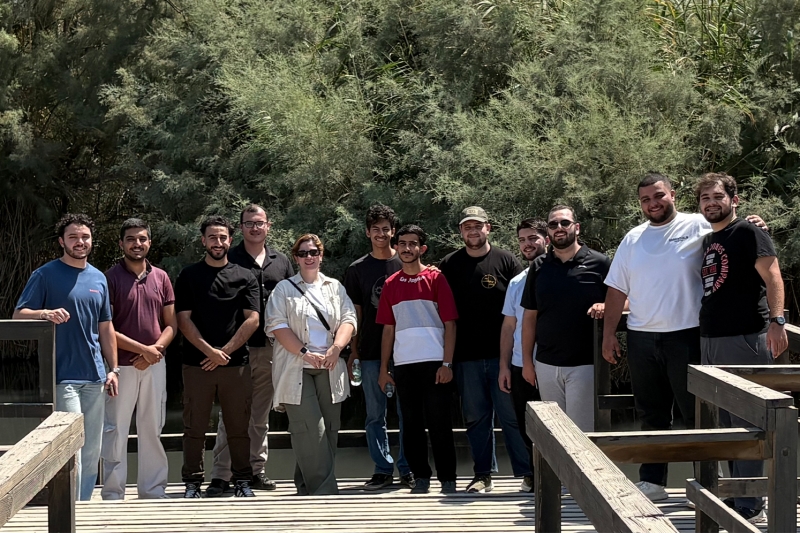
 The German–Jordanian Political Education and Youth Engagement Initiative (NextGen GJU) through the Deanship of Student affairs (DSA) at the German Jordanian University (GJU) organized an educational field visit to Azraq on Sunday, 16 August 2026, under the theme “Water: Traces of Life.”
The visit aimed to deepen students’ understanding of water security, climate change, wetland conservation, biodiversity, sustainable agriculture, and the historical significance of the Azraq region. The programme combined field-based learning with direct dialogue involving environmental specialists, local experts, and community stakeholders, enabling students to connect scientific knowledge with local realities and potential solutions.
The visit also supported students’ participation in the German–Jordanian photography competition “Water: Traces of Life,” organized by the German–Jordanian Society (Deutsch-Jordanische Gesellschaft e. V.). Throughout the day, students used photography to document the presence and absence of water and its environmental, social, agricultural, and historical implications.
Exploring Water and Biodiversity at Azraq Wetland Reserve
The programme began with a visit to Azraq Wetland Reserve, where the students met with the reserve’s manager, Eng. Hazem Harisha. He introduced them to the ecological importance of the Azraq Oasis and presented the reserve’s major expansion and habitat-rehabilitation projects, which seek to preserve the oasis’s sustainability and restore its biodiversity.
The discussion addressed declining water resources, the collection and management of rainfall in the reserve’s pools during winter, and the role of conservation and rehabilitation measures in supporting the wetland ecosystem. Students also learned about the reserve’s international significance as a major stopover for migratory birds travelling between Europe, Asia, and Africa, and as one of Jordan’s most important wetlands recognized under the Ramsar Convention.
During the dialogue, student Hashim Al-Safadi raised questions about the reserve’s plans for managing rainwater, collecting it in pools, reducing water loss, and supporting the oasis’s water and ecological systems in subsequent seasons. The students also proposed several nature-based solutions, including wetland restoration, improved retention of water in soil and vegetation, and more effective management of surface runoff. These proposals were discussed in light of scientific evidence and the needs of the local community.
Student Ammar Al-Mani asked about international agreements related to wetland protection and the role of Jordanian–German cooperation in supporting the reserve’s development and rehabilitation programmes. Student Dawood Al-Qatawneh explored the reserve’s future vision and the possibility of creating stronger connections between the wetland and Azraq Castle. The discussion highlighted the potential for integrating the oasis’s environmental value with the region’s historical and geological significance through ecological and cultural tourism.
The students also met environmental researcher Tamer Aqili, who explained his work in studying and monitoring water using instruments that measure salinity and other physical and chemical indicators. He emphasized the importance of regular monitoring in identifying changes in water quality and assessing their effects on vegetation and wildlife.
The discussion extended to migratory and resident bird species recorded in Azraq, including rare species, and the effects of climate change, rising temperatures, variable rainfall, and declining water availability on migration patterns and habitats. Azraq Wetland Reserve hosts approximately 329 migratory and resident bird species, as well as the Azraq killifish, Aphanius sirhani, the only vertebrate species endemic to Jordan.
NextGen GJU founder Da’ad Nazzal also discussed with the specialists the findings of a recent scientific study conducted by Eng. Hazem Harisha and researcher Tamer Aqili. Using satellite imagery, remote-sensing techniques, and the Normalized Difference Vegetation Index, the study found that vegetation cover increased from 2.30 square kilometres in 2015 to 14.83 square kilometres in 2025, representing an increase of approximately 545% over ten years.
The discussion examined how environmental protection, restrictions on overgrazing and encroachment, habitat rehabilitation, and science-based management contributed to this recovery. The students also considered the broader significance of the findings for combating desertification, stabilizing soil, and improving habitats for migratory birds and other wildlife.
Reading Azraq’s Water History Through Its Castle
The students then visited Azraq Castle, where they explored the relationship between water, human settlement, and political and military history in Jordan’s Eastern Desert. Located near the oasis and along historically important routes, the castle held strategic significance because of the availability of water in an otherwise arid region.
Students examined the castle’s distinctive architecture, constructed largely from locally sourced black basalt, and learned about the successive civilizations and political powers associated with the site. The location was used during the Nabataean, Roman, Byzantine, Ayyubid, and Ottoman periods. The castle is also associated with the events of the Great Arab Revolt, when it served as a base during 1917 and 1918.
The students observed the well inside the castle and the visible effects of its declining water level. This enabled them to interpret the environmental history of Azraq through physical and archaeological evidence. The visit illustrated how the oasis shaped human settlement, mobility, trade, and military strategy over centuries, and how the present decline in water resources has become a tangible record of the environmental transformations affecting the region.
Connecting Students with Local Agricultural Experience
The field programme concluded with a meeting with agricultural engineer Mohammad Al-Khataybeh, who discussed the agricultural and economic importance of Azraq and the challenges confronting local farmers. These include water scarcity, the salinity of groundwater and soil, rising production costs, climate-related pressures, and the difficulty of balancing agricultural livelihoods with the sustainable management of natural resources.
Students discussed potential responses, including water-efficient irrigation technologies, crops suited to saline and arid conditions, the use of local agricultural knowledge, and the creation of stronger channels of cooperation among young people, researchers, and farmers.
The dialogue emphasized that technically sound solutions must also respond to the economic and social circumstances of farming communities. Connecting students directly with farmers and agricultural specialists can support the exchange of knowledge, encourage youth-led research, and help develop practical initiatives grounded in local needs and experience.
From Field Learning to Student-Led Dialogue
The visit enabled students to understand Azraq as an interconnected system encompassing water, wetlands, biodiversity, agriculture, history, cultural heritage, and local communities. It also strengthened their ability to formulate questions, analyse challenges from multiple perspectives, engage with specialists, and discuss nature-based and community-informed solutions.
Photography served as an additional instrument for research, documentation, and creative expression. The students photographed signs of water scarcity, environmental recovery, agricultural adaptation, cultural memory, and the relationship between water and everyday life. Their work will contribute to their participation in the German–Jordanian Society’s “Water: Traces of Life” photography competition, which encourages comparative and transcultural engagement with water-related experiences in Jordan and Germany.
In the next phase, students will connect the visit’s findings with a series of discussions involving stakeholders, specialists, and decision-makers. Their observations, photographs, and field reflections will subsequently inform student discussion papers addressing water management, ecosystem restoration, sustainable agriculture, and ecological and cultural tourism in Azraq.
This process reflects NextGen GJU’s educational approach: moving from field-based learning and visual documentation to informed civic dialogue and, ultimately, to youth-led proposals grounded in scientific evidence and community experience.
These activities are part of the Deanship of Student Affairs’ ongoing efforts to promote learning beyond the classroom and broaden student engagement with national issues of environmental, social, and political significance.