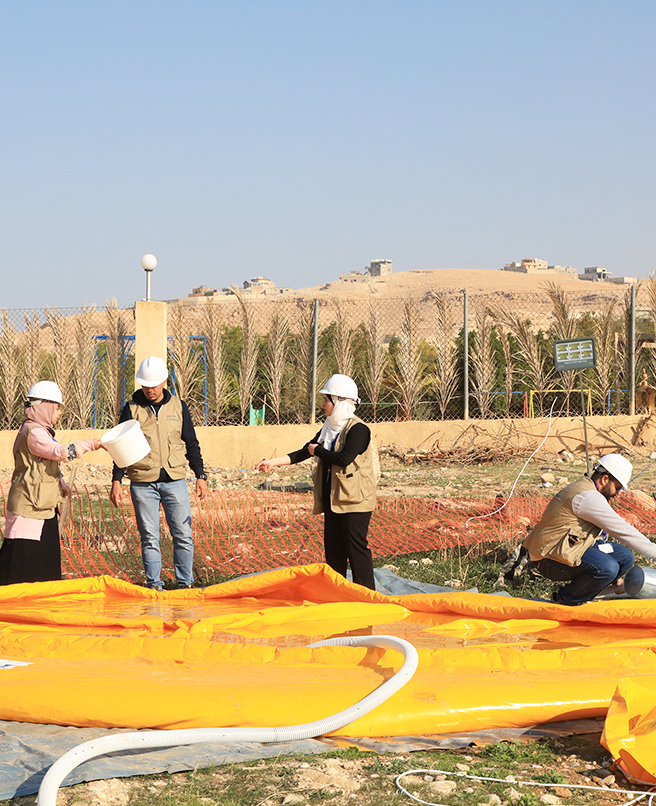

As prolonged conflicts, natural disasters, water scarcity, climate change, and disease outbreaks continue to impact the Middle East region, it is likely that the region will continue to face humanitarian needs for years to come. Water, sanitation, and hygiene (WASH) needs are among the top priorities in most countries in the region, prompting a range of humanitarian actors to get involved in addressing these needs.
More and more humanitarian actors rely on local capacities to provide assistance for their humanitarian activities or to lead interventions independently to meet the basic needs of the affected populations. However, even if local capacities exist and are based on strong academic qualifications, what is often missing is the humanitarian mindset and experience that would allow for full implementation and the transfer of more senior roles to national experts in the humanitarian sector.
To be able to develop national capacities in the Middle East, and in some cases globally, the German Jordanian University (GJU), Action Against Hunger, and Bioforce, in partnership with UNICEF and the Global WASH Cluster and other humanitarian organizations, will launch a Master's program in Water, Sanitation, and Hygiene (WASH) in February 2021. The aim of this master's program is to build the capacities of local WASH professionals and help provide the necessary human capital to respond to the region's humanitarian crises, while increasing interest in potential future specialists entering this field. The Master's degree in WASH is the result of several years of work in the WASH field in the humanitarian context across the region. The one-and-a-half-year academic program includes two semesters of theoretical education at the German Jordanian University, one semester of practical training with a humanitarian organization, and a final semester to complete the master's thesis.
For more information, visit the WaSH MSc website.