
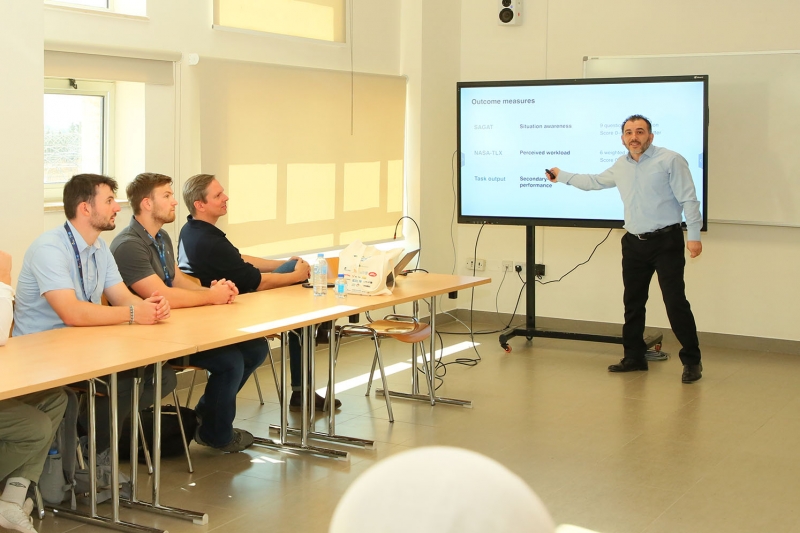
 As part of the Future Tech Summit 2026, the German Jordanian University (GJU) organized the Fourth International Conference on Sustainable Mobility Applications, Renewables and Technology (SMART 2026) on Monday. The conference brought together researchers, academics, and experts from local and international universities, research institutions, and industrial organizations to discuss the latest research and technological developments and engineering solutions supporting sustainability.
The conference highlighted renewable energy, sustainable mobility, and technology through a scientific programme featuring five plenary sessions and a series of specialized sessions addressing energy systems, electrical engineering, sustainable buildings and cities, and electric transportation technologies.
The five plenary sessions addressed Hydrogen at the Heart of the Energy Transition in the Digital Era; Sustainability of Power Semiconductors; Variable Flux Permanent Magnet Machines: Recent Developments, Future Trends, and Applications; From the Human Step to Artificial Intelligence: The Revolution of Movement; and Power Electronics Beyond Power Conversion. Dr. Shiori Idaka delivered the second plenary session on the sustainability of power semiconductors.
In the field of sustainable buildings and cities, four specialized sessions explored Sustainable Buildings and Cities: Integrating Technology, Design, and Human Behavior, while two sessions focused on Nanotechnology, Functional Materials, Surface Engineering and Sustainable Technologies. The programme also included a session on Renewable Energies and Advanced Control Systems Integration in Sustainable Applications, as well as another addressing Sustainability Enhancement through Recycling and Circular Economy Strategies. A further session examined Renewable Systems: Energy Efficiency and Power Quality Enhancement.
In electrical engineering, two sessions addressed Electric Machine Design, Modelling, and Features Investigation: Integration in Sustainable Applications. Another specialized session explored High-Quality Electrical Machines and Advanced Drive Control for Electrified Transportation Applications. The programme also covered Drives, Converters, and Control Strategies Dedicated to Sustainable Applications, alongside Advanced Electrical Machines and Drive Systems: Design, Reliability and Thermal Management.
Other sessions addressed Leadership, Social and Ethical Roots within Sustainability Frameworks, as well as SMART Grids: Techno-Economic Assessment and Optimization Challenges. In the field of electric mobility, one session examined NextGeneration EV Charging: WPT, Power Electronics and Grid Services. The programme also featured a specialized session titled ODYSSEV.
Through its parallel and specialized sessions, the programme provided opportunities to discuss a wide range of engineering and technological topics and exchange knowledge and expertise on solutions and applications supporting renewable energy, sustainable mobility, and improved system efficiency.
The conference also provided a scientific platform for presenting research, exchanging expertise, and exploring opportunities for collaboration on research and applied projects. These efforts strengthen the integration of scientific research and practical application and support the development of solutions to challenges related to energy, transportation, and the environment.
The conference reflects GJU’s commitment to supporting applied scientific research, strengthening academic and industrial cooperation at local and international levels, and connecting scientific knowledge with practical applications. These efforts contribute to developing technological solutions that respond to local and regional needs and support sustainable development.