
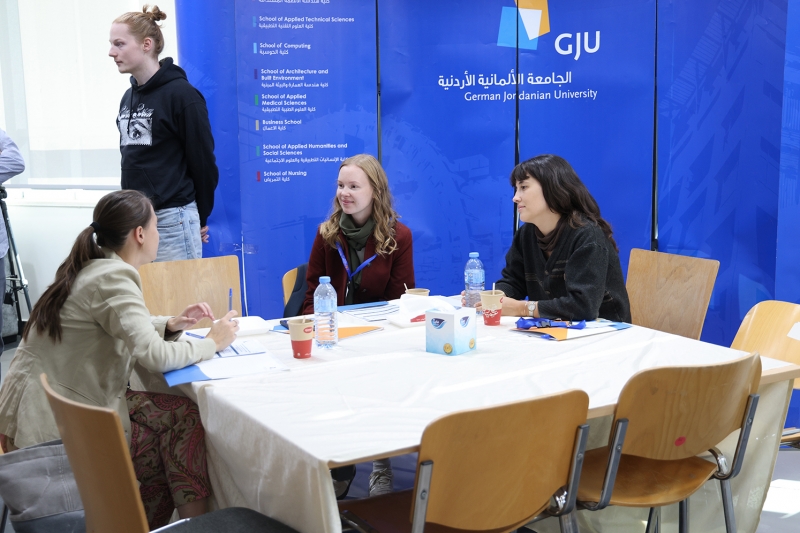
 The German Jordanian University (GJU), through its School of Applied Humanities and Social Sciences (SAHSS), organized a two-day International Symposium: “Social Work & Mental Health in Crisis Scenarios: Bridging Theory, Research, and Practice” with the participation of academics, researchers, specialists, and representatives of academic and professional institutions from Jordan and Germany. The symposium aimed to facilitate knowledge exchange and strengthen cooperation in addressing the humanitarian and social challenges arising from crises.
The symposium programme featured discussion sessions addressing the psychological and social challenges faced by individuals and communities during crises, as well as ways to advance professional practices and strengthen the integration of scientific research and practical application, thereby contributing to improved services for affected populations.
In his remarks, GJU President Prof. Ala’aldeen Al-Halhouli emphasized the role of universities in serving society and responding to humanitarian challenges. He noted that the consequences of crises extend beyond their immediate effects to affect mental health, family stability, and social cohesion, underscoring the need for coordinated academic and professional efforts to provide the necessary support to affected individuals and communities.
He also stressed the importance of bridging scientific research and professional practice and preparing qualified professionals capable of identifying needs, providing appropriate support, and protecting vulnerable groups. He further highlighted the role of international cooperation and knowledge exchange in developing evidence-based responses that address communities’ needs.
For his part, GJU Vice President for International Affairs Prof. Ralf Roßkopf highlighted the importance of promoting peaceful coexistence, harmony, and mutual respect, while fostering tolerance, human solidarity, and social cohesion. He noted that these values play an important role in addressing crises and humanitarian challenges and promoting a culture of peace and understanding, particularly amid the crises and tragic events affecting the region.
Meanwhile, Dean of SAHSS Prof. Haytham Thawabih highlighted the importance of social work and mental health in supporting individuals and families during crises and strengthening communities’ capacity to recover and overcome challenges.
He also outlined the School’s efforts to develop specialized academic and professional programmes, including the Professional Diploma in Mental Health and Community Work, the Clinical Social Work track, and the PhD programme in Social Work, offered in cooperation with the University of Hamburg. These programmes contribute to advancing education, scientific research, and professional practice in Jordan and the region.
For her part, Head of the Social Work Department Dr. Tamara Al-Rawwad emphasized the importance of strengthening the role of social work in supporting individuals and families during crises and advancing research-based professional practices to address the needs of affected populations and enhance communities’ capacity to recover. She also highlighted the importance of integrating theory and practice and facilitating knowledge exchange between academics and practitioners.
The symposium forms part of GJU’s efforts to strengthen academic and professional cooperation, promote knowledge exchange between researchers and practitioners, and encourage joint research and initiatives that contribute to advancing mental health and social work services and strengthening individuals’ and communities’ capacity to address crises and their consequences.