
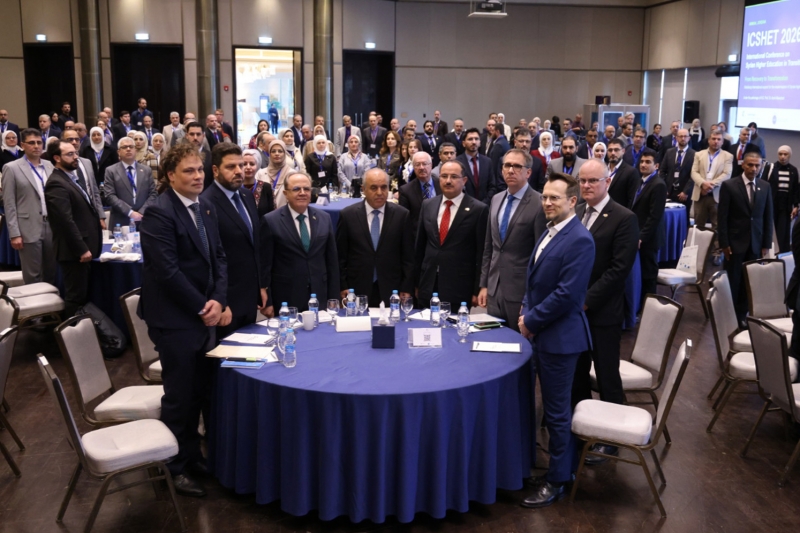
 The German Jordanian University (GJU) organized the International Conference on Syrian Higher Education (ICSHET 2026) today in cooperation with the German Academic Exchange Service (DAAD), under the theme: “Syrian Higher Education: From Recovery to Institutional Transformation – International Partnerships for Reintegration into Regional and International Academic Communities”.
The conference, which continues for three days under the patronage of Minister of Education and Human Resources Development Prof. Azmi Mahafzah, brings together senior official and academic representatives from Jordan, Syria, and Germany, alongside representatives of several international organizations. It aims to explore pathways for rebuilding and developing the Syrian higher education system and strengthening academic and research partnerships.
During the opening ceremony, GJU President Prof. Ala’aldeen Al-Halhouli affirmed that Jordan, under the leadership of His Majesty King Abdullah II, has consistently supported international humanitarian and development efforts, drawing on its deep-rooted historical ties with Syria and its firm belief that investing in people and education is the most important pathway toward stability and prosperity.
Prof. Al-Halhouli explained that GJU, established through a strategic partnership between Jordan and Germany and connected to a network of more than 120 German universities, has leveraged its institutional expertise in managing international projects and applied education to support Syrian and Jordanian youth. He highlighted the “EDU-SYRIA” program, implemented in partnership with the European Union and DAAD, and reaffirmed the readiness of Jordanian universities to strengthen cooperation with their Syrian counterparts in capacity building, academic exchange, and scientific research, helping turn ideas into projects with sustainable impact.
For his part, Syrian Minister of Higher Education and Scientific Research Prof. Marwan Al-Halabi expressed his appreciation to Jordan and DAAD for organizing the conference. He emphasized that Syrian higher education is now at the threshold of a new phase, moving from restoring its capabilities and repairing the damage to achieving comprehensive institutional transformation and building the future.
Prof. Al-Halabi noted that the envisioned institutional transformation is based on good governance, quality assurance, problem-solving-oriented scientific research, digital transformation, and curriculum modernization. He also affirmed Syria’s openness to regional and international academic communities through a commitment to partnership and integration that respects national identity and strengthens the ability of Syrian universities, researchers, and students to generate knowledge.
Meanwhile, DAAD Secretary General Dr. Kai Sicks emphasized that higher education represents a fundamental pillar of sustainable reconstruction in Syria, stressing the importance of the principle of “Syrian ownership and leadership” in shaping the future of the academic sector, with support from international partners.
Dr. Sicks reviewed the initiatives launched by DAAD since early 2026 to support Syrian higher education. These included the selection of 12 German-Syrian university partnership projects, including the (SyrIA) project in partnership with GJU; the training of more than 100 Syrian academics through DAAD’s Cairo Academy; and funding teaching and research visits for 40 Syrian researchers residing in Germany, with the aim of strengthening academic networking and facilitating knowledge and expertise transfer.
In turn, Head of the Culture and Media Section at the German Embassy in Amman Dr. Martin Lohr explained that holding the conference reflects an important shift from the phase of urgent humanitarian response to long-term planning and institutional reform in Syria.
Dr. Lohr affirmed Germany’s commitment, through the Federal Foreign Office, DAAD, and the European Union, to supporting the “Syrian Innovation in Academia” project (Syria-IA), implemented by GJU. He highlighted the importance of drawing on the expertise of Syrian academic professionals abroad and connecting them with universities inside Syria to build modern educational institutions that drive development.
The conference program includes high-level panel discussions and keynote lectures addressing the findings of the fact-finding mission in Syria, recovery and modernization priorities in Syrian higher education, experiences in rebuilding universities, and the role of international partnerships in supporting higher education during crises.