

Laboratories
The facility of this lab is intended to provide the students with skills that are required to develop their knowledge for various computer science courses
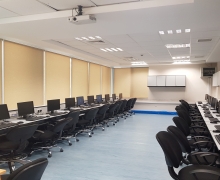
The facility of this lab is intended to provide the students with skills that are required to develop their knowledge for various computer science topics such as: Data structures, Data Bases, and computer graphics.
Lab Resources: Desktop computers
Courses
The facility of this lab is intended to provide the students with skills that are required to develop their knowledge for the fundamentals of computer programming
Lab Resources
- Desktop computers
Software
This lab introduces students to the field of computer networks. It covers networking architecture, structure, and functions, along with the principles and structure of IP addressing and the fundamentals of Ethernet concepts, media, and operations. Together, these topics provide a solid
Developing a good understanding of a few important concepts in Mechanics, Electricity, and Magnetism. Learning to apply these concepts to familiar and unfamiliar situations and Gaining the ability to reason qualitatively and quantitatively. This lab consists of 11 experiments, six in Mechanics
This lab is intended to provide the students with skills that are required to develop their knowledge for various computer science topics such as: Data structures, Data Bases, and computer graphics
Lab Resources
- Desktop
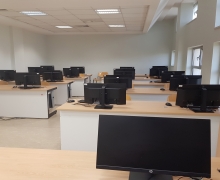
The facility of this lab is intended to provide the students with skills that are required to develop their knowledge for advanced programming topics such as: Object-oriented and web programming
Lab Resources - Desktop Computers - Courses taught in the lab
Computing fundamentals
This lab introduces students to the principles and concepts of linux operating system. also it focuses on using commands, tools and techniques in Linux .
- High capability LENOVO Desktop Computers integrated with core I7 CPUs and ASUS Dual series of GeForce GTX
This lab is used for Microprocessor and Microcomputer Systems to introduce theoretical concepts of 8-bit and 16-bit microprocessors including microprocessor architecture, memory organization, instruction set, input/output organization, and interrupts.
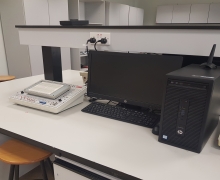
This lab is used for Digital Systems to introduce students to the fundamentals of designing and building digital circuits using hardware ICs and focuses on building combinational and sequential circuits, which give the students a good understanding of the basic tools used in