
Geoheritage Conference Session
Introduction
In recent years several efforts from around the world have started to focus on promoting geoheritage. These efforts resulted in registering 195 sites from 48 countries so far, of which some are transboundary sites. The Arab region contains many unique geological features that include breathtaking landscapes that attract adventure tourism and showcase unique geo and biodiversity. Some of these geological sites have been placed on the UNESCO world heritage list as mixed sites (Natural and Cultural Heritage), such as Wadi Rum Jordan, or as a natural outstanding landscape site such as Wadi al-Hitan in Egypt. While the UNESCO World Heritage List has several natural landscape sites inscribed, only Morocco has a site inscribed on the UNESCO Global Geopark list, which is the M’Goun geopark. As a contrast, Germany has 16 geoparks. Thus, it is important to learn from other countries’ experience, without falling into the trap of registration obsession.
Although the awareness towards the geoheritage in the Arab countries is not new, efforts towards its protection vary. While Tunisia issued a law on the Valuation and Protection of Geological Heritage in 2018, Jordan has only recently established a national committee for geoparks. While Tunisia is recently working on creating a database for its geological features, a database for southeastern Arabia has been developed.
Unlike cultural heritage, which can be easily detected and understood, geoheritage is more subtle, making it very vulnerable to damage, from mining for natural resources, urban encroachment, expanding development into remote areas, neglect, and pollution and even tourism are just some of the hazards facing this heritage. In addition to the lack of awareness on all levels of its importance.
Several national, regional and international institutions have started to increase their efforts towards valorizing and protecting geoheritage in the Arab region. Although all these efforts are indeed welcomed, they can still be considered as shy, low-key efforts that sometimes hamper each other. Even within single countries, several entities, both governmental and private, can be working separately on the same goals without knowing of the other’s efforts and results. In this global world, it is important to learn from other countries’ experiences, build a network and work on promoting this unique heritage that tells the story of our planet Earth.
The conference sessions:
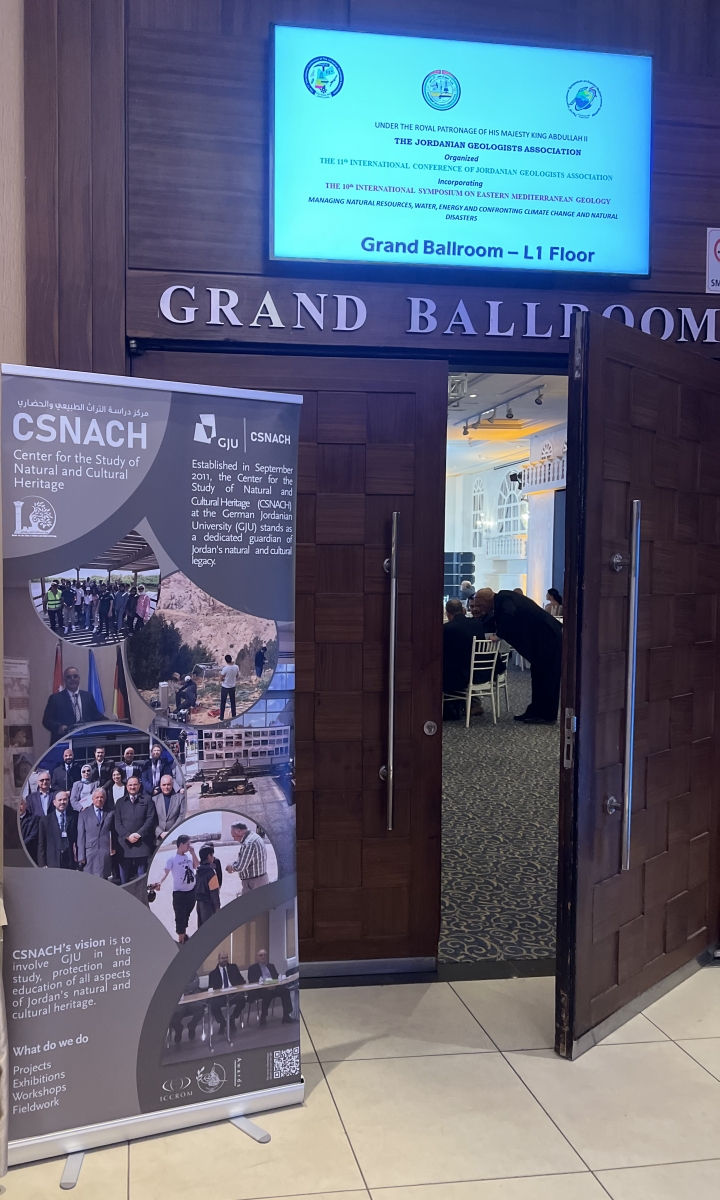
In conjunction with the 11th International Conference of the Jordanian Geologist Association and the 10th International Symposium on Eastern Mediterranean Geology, which was held in Amman from October 22–24, 2024, the Center for the Study of Natural and Cultural Heritage (CSNACH) organized a special "Geoheritage" session. Attendees from Palestine, Syria, Spain, the United Kingdom, Japan, Tunisia, and Jordan presented in the two sessions and participated in panel discussion along with colleagues from 25 countries on Wednesday, October 23, 2024. Eleven scholarly papers (from 16 originally accepted for the conference) were presented on subjects including communicating geoheritage and geotourism, water and ecosystems in Global geoparks, and geological wonders were presented.
This was the 1st time geoheritage topic is introduced into the International Conference of the Jordanian Geologist Association and was highly welcomed with a large attendance and lively discussions.
The session program:
|
Time |
Session moderator |
Speaker |
Paper title |
|
09:00
09:20
09:40
10:00
10:20 |
Dr. Iain Stewart |
Iain Stewart, |
Communicating Geoheritage to Stakeholders and Communities |
|
Kenta Sayama |
Advancing geoheritage research in southeast Arabia: endangerment analysis, evaluation, and science communication |
||
|
Catreena Hamarneh & Nizar Abu-Jaber
|
Geoscience dissemination to the general public between traditional methods and innovation: Jordan's example
|
||
|
Alsharifa Hind Mohammad, Marwan Ghanem, África de la Hera-Portillo, Nour-Eddine Laftouhi |
Geological Treasures of Jordan: A Vision for a Geopark |
||
|
Marwan Ghanem, Alsharifa Hind Mohammad, Africa de la Hera-Portillo, nour-Eddine Laftouhi |
Impact of Climate Change on the hydrological system of the Ein Sultan spring in the potential Jericho Geopark in Palestine. |
||
|
11:00-12:00 |
Nizar Abu-Jaber |
Panel Discussion |
Ahmad Gharaibeh Iain Stewart Catreena Hamarneh |
|
12:00
12:20
12:40 |
Nizar Abu-Jaber and Catreena Hamarneh |
A. De la Hera-Portillo, M. Llorente-Isidro, M. Ghanem, Alsharifa Hind Mohammad, Nour-Eddine Laftouhi, J. López-Gutiérrez, D. Ballesteros, M. Alamparte. |
Identification and hydrogeological characterization of groundwater dependent ecosystems in montañas do courel unesco global geopark (Spain) |
|
África de la Hera-Portillo, Elvira Ester Musakka, Pedro Martínez-Santos, Karmah Salman, Jose Ángel Sánchez, Marwan Ghanem, Alsharifa Hind Mohammad, Nour-Eddine Laftouhi. |
Typologies of springs in las loras unesco global geopark (spain): hydrogeological heritage and sustainability implications |
||
|
|
|
Ahmad Gharaibeh |
Protection of geological heritage in Jordan. |
|
Nizar Abu Jaber & Catreena Hamarneh
|
The Geology of World Heritage Sites in Jordan, the neglected subject |
||
|
Soumaya Ayadi Maasri |
Defining geosites criteria as assets for tourism and sustainable development |
||
|
Mamoon Allan |
Geotourism in Jordan; potential, challenges and implications. |
The panel discussion:
The panel discussion was inaugurated by a welcoming word from Dr. Özlem Adiyaman Lopes Programme Specialist for UNESCO-UNESCO Global Geoparks, and participation of local specialist on Geoparks.
Dr. Adiyaman Lopes, who participated via teams, gave an overview on the history of geoparks, current statues of the geoparks around the world, the requirements for the nomination and the process offering UNESCO’s willingness to support.
This was followed by discussions from the audience covering issues of governance, regulations, threats on the geoheritage, communications, unification of terms awareness, the importance of networking within the various specialist and the need to create more workshops on this subject matter.
Recommendations of the session on geological reserves and geotourism
1. Regarding geotourism:
- An expanded meeting was held for all official and private bodies concerned with tourism in Jordan to develop a road map for the development of geotourism in Jordan.
- The necessity of developing the training curriculum for tourist guides in terms of geological information and methods of presenting it.
- The necessity of a multi-level discourse to market geotourism.
- Working with local communities and educating them about the importance of geological heritage and the necessity of preserving it.
2. Regarding geological reserves
- Establishing an Arab/international network in cooperation with UNESCO to coordinate and exchange experiences in the field of geological reserves.
- Accelerating the preparation of standards for geological reserves and issuing them in legal form in preparation for approval.
- Unifying local and Arab efforts regarding nominating and working on geological reserve files.
3. Regarding geological heritage:
- The necessity of issuing instructions to control the illegal trade in fossils and minerals.
- Preparing educational programs and developing curricula for teaching geology to include geotourism and geological reserves.
- Establishing a national geological museum.
If you would like to join Arab Geopark Network, please write to